

Most insurance accepted. Click for details

Adderall and High-Functioning Addiction: When Performance Becomes Dependence

Adderall and High-Functioning Addiction- When Performance Becomes Dependence

than to get high. With this type of use, the drug quietly becomes necessary to perform at all.

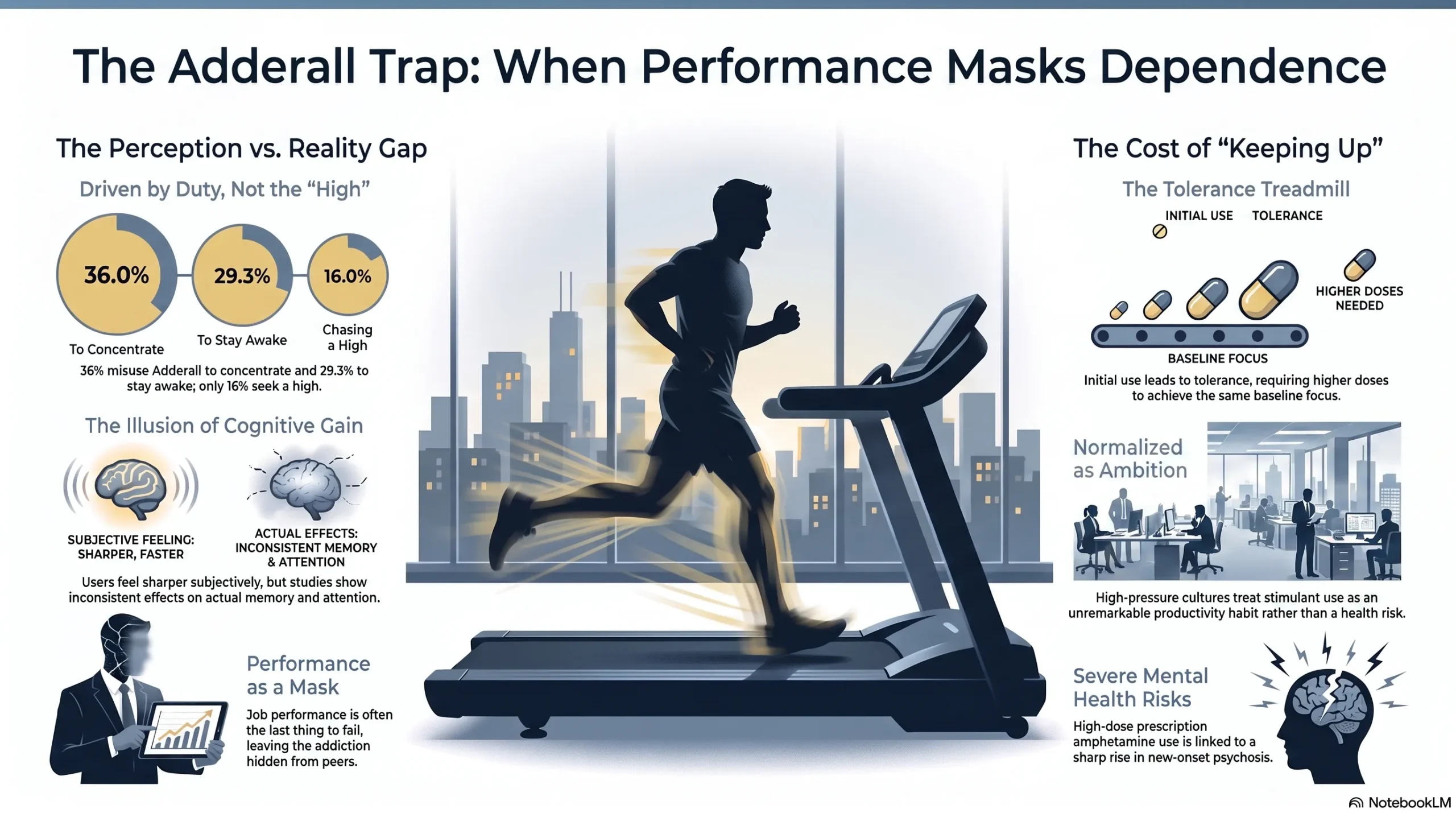
A review found that about 36% of people who misused this medication for Attention-Deficit/Hyperactivity Disorder (ADHD) did so to concentrate, and another 29.3% did so to stay awake, compared with only 16% chasing a high [1]. That performance-first motive is exactly what lets dependence hide in plain sight.

The Performance Trap: How Adderall Use Turns Into Dependence

Adderall increases dopamine and norepinephrine in the brain, producing sharper focus, more energy, and increased alertness during a demanding stretch of work or school. For many ambitious professionals or students, that first experience feels less like drug use and more like finally keeping up.

What’s the downside? Long-term use, even at a prescribed dose, can lead to tolerance, meaning the same dose produces a weaker effect over time and a higher dose is needed to get the same original result [2]. Someone who only used Adderall before a big presentation may find they cannot get through an ordinary Tuesday without the drug.

What Is High-Functioning Addiction?

High-functioning addiction describes someone who continues to meet job, school, or family responsibilities while dependent on a substance. Job performance is often the last thing to break down, not the first, so the person and the people around them may not recognize a problem until it has become severe.

Why Adderall Specifically Attracts Top Performers

Unlike some addictive substances, Adderall comes with a doctor’s approval and a legitimate medical use. Many people do not perceive a drug prescribed for attention problems as dangerous — even when it is used without a prescription, at a higher dose, or simply because a deadline is close.

This reasoning is common in competitive academic programs, sales-driven roles, and industries that reward constant output. Because performance is treated as evidence of health, the underlying problem stays hidden.
An infographic titled "The Adderall Trap: When Performance Masks Dependence" detailing the gap between perception and reality in stimulant misuse, the illusion of cognitive gains, and the tolerance treadmill alongside severe mental health risks.Does Adderall Actually Make People Better at Their Jobs and Studies?

Not reliably. A placebo-controlled study of healthy college students without ADHD found that Adderall produced only small, inconsistent effects on cognitive skills, such as memory and sustained attention.

On the other hand, it also produces large effects on mood, energy, and the subjective feeling of being sharper [3]. People often feel more capable on Adderall without objectively becoming more capable.

High-Pressure Industries and Everyday Access in the Bay Area

The Bay Area’s concentration of technology, finance, and demanding academic environments creates a particular risk for Adderall addiction. Long hours and constant output are often treated as ordinary. This potentially makes the use of stimulants an unremarkable productivity habit.

Between a large population of people with legitimate ADHD prescriptions, a well-resourced healthcare system, and a culture that already normalizes cognitive-enhancement talk, Adderall is relatively easy to find and use.

Is Adderall Misuse Different in a High-Performance Culture?

Not different in its biology, but different in how it is normalized. Stimulant use can look like ambition rather than a substance use problem.

The Hidden Health Risk Behind the Performance

The risks of Adderall misuse extend well past behavior. Research found that people who had recently taken prescription amphetamines, such as Adderall, faced a higher risk of new-onset psychosis or mania, and that risk rose sharply at higher doses [4].

The Crash: What Happens When High-Functioning Use Stops

Long-term stimulant use changes the way the brain regulates energy and motivation, so stopping, or even running out for a few days, can bring on withdrawal [5].

People often describe a crash that includes exhaustion, low mood, and trouble concentrating, which are, ironically, close to the symptoms Adderall is supposed to mitigate.

Does Stopping Adderall Feel Like Withdrawal or Just Tiredness?

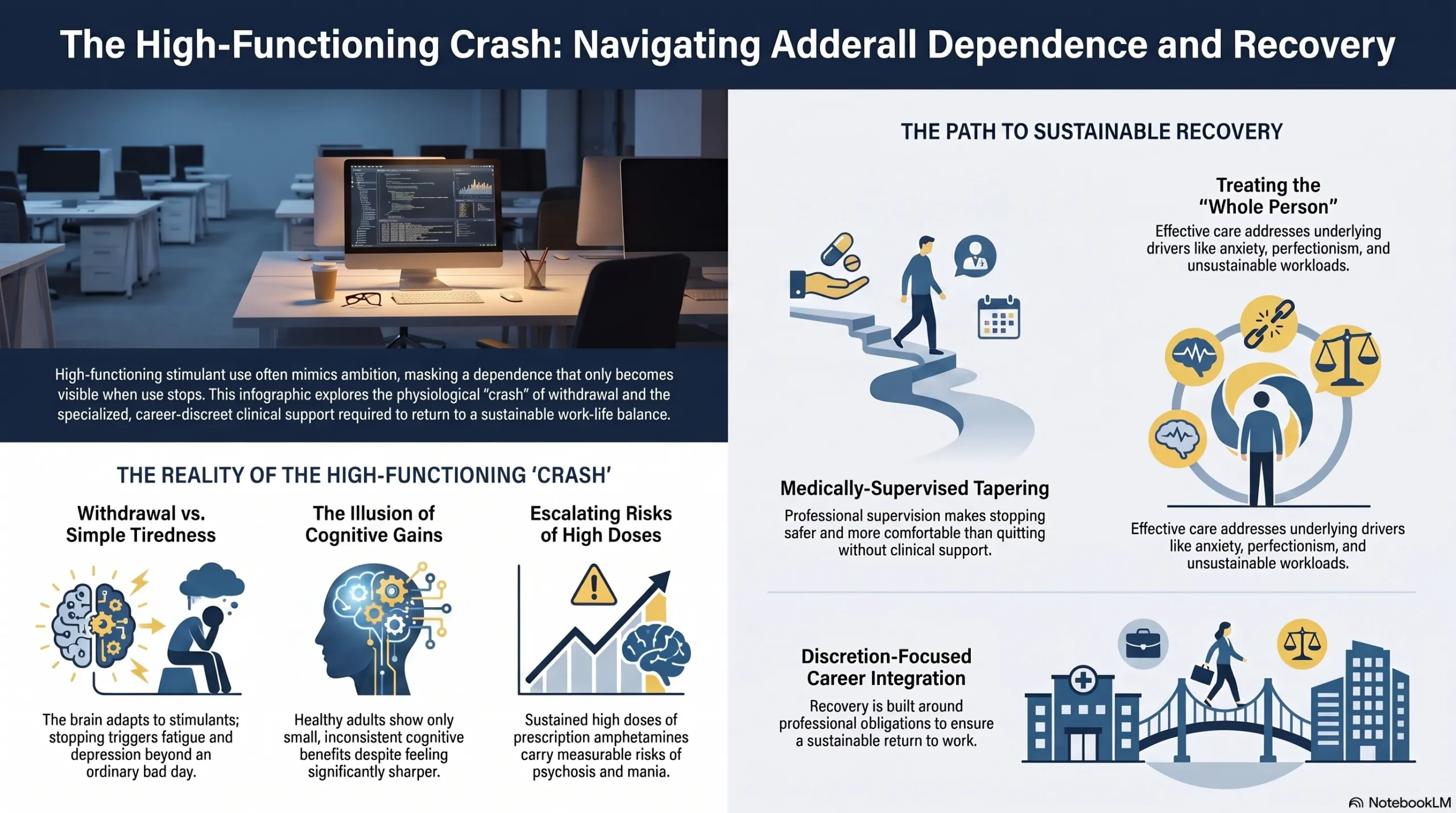
It can feel like both, but the underlying cause is withdrawal. Because the brain has adapted to the drug’s presence, removing it can trigger fatigue, increased appetite, and a depressed mood that lasts well beyond an ordinary bad day [5].

Medical supervision makes stopping safer and considerably more comfortable, especially after a long period of escalating use.

Why High-Functioning Dependence Needs a Treatment Plan

An honest evaluation is required before quitting. Some people who misuse Adderall have undiagnosed ADHD and would benefit from an accurately prescribed, monitored dose. Others do not have ADHD and are using the drug to keep pace with an unsustainable workload [5].

Because high-functioning dependence often coexists with anxiety, perfectionism, or an unaddressed mood disorder, effective care treats the whole person rather than the substance use in isolation.

Approaches such as Motivational Enhancement (ME) help one’s own reasons for change against what continued use already costs you, without shame or ultimatums.

Can You Get Treatment Without Derailing Your Career?

Yes, and discretion is central to making that possible. A thorough evaluation, individual therapy, and medically-supervised tapering can happen in a private, structured setting built around you and your professional obligations. The goal is a sustainable return to work and life, not a permanent exit from either.
An infographic titled "The High-Functioning Crash" explaining the withdrawal reality versus simple tiredness, escalating risks of high doses, and paths to sustainable recovery including medically-supervised tapering and treating the whole person.What Matters Most

  • High-functioning Adderall addiction lets someone keep working, studying, or performing while depending on the drug to feel normal, which delays recognition of addiction and treatment.
  • Most people who misuse ADHD stimulants do so to concentrate or stay awake, not to get high, so the pattern can look like ambition rather than addiction.
  • Research on healthy adults without ADHD finds only small, inconsistent cognitive benefits from Adderall, even though users often feel noticeably sharper.
  • High doses of prescription amphetamines carry a measurable, dose-dependent risk of psychosis and mania.
  • Stopping after sustained use produces withdrawal, not just tiredness, and requires medical support.
  • Effective treatment addresses the pressures driving the use, not only the substance itself.

Welcome to Top-Tier Residential Drug and Alcohol Recovery

If you or a loved one is struggling with Adderall or another prescription stimulant, Alta Mira Recovery offers a level of clinical depth many Bay Area programs cannot match.

Every client receives a full psychological and medical evaluation at intake, so a case involving both ADHD and stimulant use disorder is treated as one coordinated plan.

Our credentialed clinical team takes the time to understand you, shaping a course of care around your specific needs.

Talk With Admissions

Sources

[1] Maglione, M.A., et al. 2026. Adult Misuse of ADHD Stimulant Medication in the United States: A Rapid Review. Journal of Clinical Psychopharmacology.

[2] Handelman, K. and Sumiya, F. 2022. Tolerance to Stimulant Medication for Attention Deficit Hyperactivity Disorder: Literature Review and Case Report. Brain Sciences, 12(8), Article 959.

[3] Weyandt, L.L., et al. 2018. Neurocognitive, Autonomic, and Mood Effects of Adderall: A Pilot Study of Healthy College Students. Pharmacy, 6(3), Article 58.

[4] Moran, L.V., et al. 2024. Risk of Incident Psychosis and Mania With Prescription Amphetamines. American Journal of Psychiatry, 181(10), 901-909.

[5] Substance Abuse and Mental Health Services Administration. 2021. Treatment for Stimulant Use Disorders. Treatment Improvement Protocol (TIP) Series, No. 33. Substance Abuse and Mental Health Services Administration.

High-functioning Adderall addiction means using the prescription drug to meet work or school demands rather than to get high. With this type of use, the drug quietly becomes necessary to perform at all.

A review found that about 36% of people who misused this medication for Attention-Deficit/Hyperactivity Disorder (ADHD) did so to concentrate, and another 29.3% did so to stay awake, compared with only 16% chasing a high [1]. That performance-first motive is exactly what lets dependence hide in plain sight.

The Performance Trap: How Adderall Use Turns Into Dependence

Adderall increases dopamine and norepinephrine in the brain, producing sharper focus, more energy, and increased alertness during a demanding stretch of work or school. For many ambitious professionals or students, that first experience feels less like drug use and more like finally keeping up.

What’s the downside? Long-term use, even at a prescribed dose, can lead to tolerance, meaning the same dose produces a weaker effect over time and a higher dose is needed to get the same original result [2]. Someone who only used Adderall before a big presentation may find they cannot get through an ordinary Tuesday without the drug.

What Is High-Functioning Addiction?

High-functioning addiction describes someone who continues to meet job, school, or family responsibilities while dependent on a substance. Job performance is often the last thing to break down, not the first, so the person and the people around them may not recognize a problem until it has become severe.

Why Adderall Specifically Attracts Top Performers

Unlike some addictive substances, Adderall comes with a doctor’s approval and a legitimate medical use. Many people do not perceive a drug prescribed for attention problems as dangerous — even when it is used without a prescription, at a higher dose, or simply because a deadline is close.

This reasoning is common in competitive academic programs, sales-driven roles, and industries that reward constant output. Because performance is treated as evidence of health, the underlying problem stays hidden.

Does Adderall Actually Make People Better at Their Jobs and Studies?

Not reliably. A placebo-controlled study of healthy college students without ADHD found that Adderall produced only small, inconsistent effects on cognitive skills, such as memory and sustained attention.

On the other hand, it also produces large effects on mood, energy, and the subjective feeling of being sharper [3]. People often feel more capable on Adderall without objectively becoming more capable.

High-Pressure Industries and Everyday Access in the Bay Area

The Bay Area’s concentration of technology, finance, and demanding academic environments creates a particular risk for Adderall addiction. Long hours and constant output are often treated as ordinary. This potentially makes the use of stimulants an unremarkable productivity habit.

Between a large population of people with legitimate ADHD prescriptions, a well-resourced healthcare system, and a culture that already normalizes cognitive-enhancement talk, Adderall is relatively easy to find and use.

Is Adderall Misuse Different in a High-Performance Culture?

Not different in its biology, but different in how it is normalized. Stimulant use can look like ambition rather than a substance use problem.

The Hidden Health Risk Behind the Performance

The risks of Adderall misuse extend well past behavior. Research found that people who had recently taken prescription amphetamines, such as Adderall, faced a higher risk of new-onset psychosis or mania, and that risk rose sharply at higher doses [4].

The Crash: What Happens When High-Functioning Use Stops

Long-term stimulant use changes the way the brain regulates energy and motivation, so stopping, or even running out for a few days, can bring on withdrawal [5].

People often describe a crash that includes exhaustion, low mood, and trouble concentrating, which are, ironically, close to the symptoms Adderall is supposed to mitigate.

Does Stopping Adderall Feel Like Withdrawal or Just Tiredness?

It can feel like both, but the underlying cause is withdrawal. Because the brain has adapted to the drug’s presence, removing it can trigger fatigue, increased appetite, and a depressed mood that lasts well beyond an ordinary bad day [5].

Medical supervision makes stopping safer and considerably more comfortable, especially after a long period of escalating use.

Why High-Functioning Dependence Needs a Treatment Plan

An honest evaluation is required before quitting. Some people who misuse Adderall have undiagnosed ADHD and would benefit from an accurately prescribed, monitored dose. Others do not have ADHD and are using the drug to keep pace with an unsustainable workload [5].

Because high-functioning dependence often coexists with anxiety, perfectionism, or an unaddressed mood disorder, effective care treats the whole person rather than the substance use in isolation.

Approaches such as Motivational Enhancement (ME) help one’s own reasons for change against what continued use already costs you, without shame or ultimatums.

Can You Get Treatment Without Derailing Your Career?

Yes, and discretion is central to making that possible. A thorough evaluation, individual therapy, and medically-supervised tapering can happen in a private, structured setting built around you and your professional obligations. The goal is a sustainable return to work and life, not a permanent exit from either.

What Matters Most

  • High-functioning Adderall addiction lets someone keep working, studying, or performing while depending on the drug to feel normal, which delays recognition of addiction and treatment.
  • Most people who misuse ADHD stimulants do so to concentrate or stay awake, not to get high, so the pattern can look like ambition rather than addiction.
  • Research on healthy adults without ADHD finds only small, inconsistent cognitive benefits from Adderall, even though users often feel noticeably sharper.
  • High doses of prescription amphetamines carry a measurable, dose-dependent risk of psychosis and mania.
  • Stopping after sustained use produces withdrawal, not just tiredness, and requires medical support.
  • Effective treatment addresses the pressures driving the use, not only the substance itself.

Welcome to Top-Tier Residential Drug and Alcohol Recovery

If you or a loved one is struggling with Adderall or another prescription stimulant, Alta Mira Recovery offers a level of clinical depth many Bay Area programs cannot match.

Every client receives a full psychological and medical evaluation at intake, so a case involving both ADHD and stimulant use disorder is treated as one coordinated plan.

Our credentialed clinical team takes the time to understand you, shaping a course of care around your specific needs.

Talk With Admissions

Sources

[1] Maglione, M.A., et al. 2026. Adult Misuse of ADHD Stimulant Medication in the United States: A Rapid Review. Journal of Clinical Psychopharmacology.

[2] Handelman, K. and Sumiya, F. 2022. Tolerance to Stimulant Medication for Attention Deficit Hyperactivity Disorder: Literature Review and Case Report. Brain Sciences, 12(8), Article 959.

[3] Weyandt, L.L., et al. 2018. Neurocognitive, Autonomic, and Mood Effects of Adderall: A Pilot Study of Healthy College Students. Pharmacy, 6(3), Article 58. 

[4] Moran, L.V., et al. 2024. Risk of Incident Psychosis and Mania With Prescription Amphetamines. American Journal of Psychiatry, 181(10), 901-909.

[5] Substance Abuse and Mental Health Services Administration. 2021. Treatment for Stimulant Use Disorders. Treatment Improvement Protocol (TIP) Series, No. 33. Substance Abuse and Mental Health Services Administration.