

Clinicians across the Bay Area increasingly treat patients who cannot say what they took. That is not a lapse in judgment: pink cocaine, 3,4-Methylenedioxymethamphetamine (MDMA), and ketamine are often sold under names describing a color or reputation, not a verified identity.
In a 2026 study, 23.7 percent of nightclub attendees tested positive for ketamine, though only 10.8 percent reported using it [1]. That gap between label and content shapes emergency care and the treatment plan you or your loved one needs.
Ketamine is a dissociative anesthetic. It was developed for surgery and is now also used, in carefully controlled medical settings, as a treatment for severe depression [5]. Recreationally, it produces detachment from the body and surroundings, ranging from a floaty, dreamlike state to the near-total disconnection some users call a “k-hole” [5].
MDMA, also known as “Molly” or “Ecstasy,” is closer to a hybrid: part stimulant, part empathogen. It drives a surge of serotonin, dopamine, and norepinephrine, producing euphoria, emotional openness, and a rush of energy, alongside physical effects such as jaw clenching, elevated heart rate, and a rise in body temperature [4].
Pink cocaine, also called “tusi,” is neither of these on its own. Despite the name, it is rarely cocaine. Since 2020, the Drug Enforcement Administration (DEA) has tested 960 seized pink powders, and only four contained the drug the name references, 2C-B; the rest were other combinations [2].
Forensic and drug-checking studies consistently find that what is actually inside is a variable cocktail built around ketamine and MDMA, often bulked with caffeine, and sometimes cut with methamphetamine, cocaine, opioids, or other adulterants [3].
There is no standard recipe. Each batch differs from the last, and neither the person using it nor a clinician evaluating them afterward can know in advance what it actually contained. Reporting on recent seizures and public health warnings across major nightlife markets shows the same pattern nationally: the label promises one thing, and laboratory testing finds another.
Usually not. The pink dye and the name were adopted to make the product recognizable and appealing, not to describe what is in it. Testing programs and law enforcement labs both point to the same pattern: ketamine and MDMA dominate, cocaine is rare, and the only thing genuinely consistent across batches is the color [2][3].
The Bay Area has one more layer of confusion that other markets do not: it is also home to a large and growing number of legal ketamine and esketamine clinics treating depression, anxiety, and post-traumatic stress. Esketamine is approved by the Food and Drug Administration (FDA) for treatment-resistant depression, and general ketamine is increasingly offered off-label in supervised clinical settings across the region [5].
This regional visibility can blur an important distinction. A person who has heard about ketamine as a legitimate depression treatment may reasonably assume that recreational ketamine, or a tusi mixture containing it, carries a similarly low risk. It does not. The difference is the dose, the setting, and the medical oversight surrounding its use.
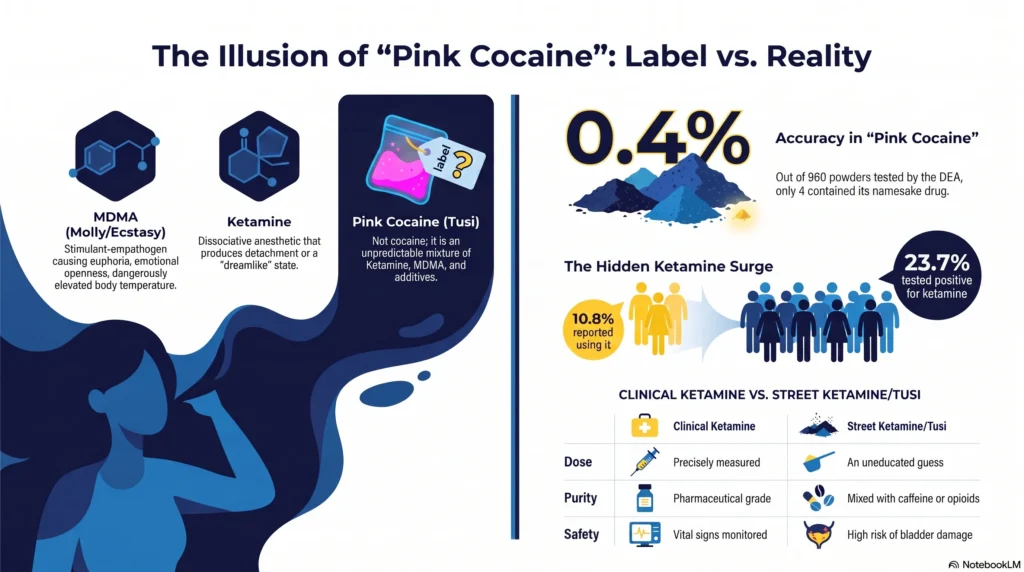
Chemically, often yes. Clinically, no. In a treatment setting, the dose is measured, the setting is monitored, vital signs are tracked, and a clinician is present the entire time [5].
On the street, the dose is a guess, the setting is uncontrolled, and the person has no way of knowing the concentration or purity of what they bought, let alone what else was mixed into it.
Recreational, unsupervised use carries risks, including bladder and urinary tract damage with repeated use, that supervised clinical use is specifically designed to avoid [6].
MDMA behaves like a stimulant crossed with an emotional amplifier. Expect energy, warmth toward other people, and a body that runs dangerously hot in a crowded club [4]. Ketamine behaves like a sedating anesthetic. Expect detachment, slowed movement, and reduced awareness of pain or surroundings [5]. Pink cocaine behaves like whichever of those two dominates in that particular batch, sometimes both at once, which is precisely why users report different experiences from what looks like the same product [3].
There is no reliable way to distinguish them by name or appearance alone. A pink powder does not indicate whether a person is about to feel stimulated or sedated. The clearer distinction lies in each substance’s intended chemical profile:
MDMA is a stimulant-empathogen; ketamine is a dissociative anesthetic; and pink cocaine is an unlabeled combination of both, plus whatever else has been added along the way [2]. Only laboratory testing reveals what a specific sample contains, and even then, the next batch may be entirely different.
Ketamine use among nightclub attendees has been climbing nationally, even as some other party drugs have leveled off, which means more people are encountering it, knowingly or not, as an ingredient in something else [7]. That matters because the danger in these substances rarely comes from one drug in isolation.
MDMA raises the risk of serotonin syndrome, a potentially life-threatening reaction marked by high fever, rapid heartbeat, and muscle rigidity, particularly when combined with other serotonergic substances [4].
Ketamine can cause dangerously slowed breathing, an effect that compounds when alcohol or opioids are also involved [5].
Pink cocaine layers these risks on top of each other and adds an unknown: because its composition is not standardized, a person may unwittingly take in stimulant, sedative, and, in some tested samples, opioid components in a single dose [3].
Call 911 for a very high body temperature, seizure, chest pain, slowed or irregular breathing, unresponsiveness, or confusion that does not resolve. Stay with your loved one, help them cool down if they feel overheated, and tell responders everything known about what was taken.
A person does not need to know the exact contents of what they took to get help. Given how often these products are mixed, it is safest to assume that more than one substance may be involved [2] [3].
An accurate treatment plan cannot be built on a street name. It depends on a clear picture of what was actually used, how often, and in what pattern, since MDMA, ketamine, and an unpredictable mixture such as tusi call for different clinical approaches.
Ketamine dependence often calls for medically supervised detox, since withdrawal and continued heavy use both carry physical risks, including the bladder and urinary tract damage documented in regular users [6].
MDMA-related concerns more often center on the emotional and psychological patterns driving repeated use, alongside monitoring for the cardiovascular and mood effects of frequent use [4].
Pink cocaine use complicates both pictures at once, since the person may not know what they were actually dependent on until an evaluation identifies it [3].
Yes, and it is common. People who use tusi are, by definition, using multiple substances at once, and research shows this pattern of polysubstance use often extends to separate use of cocaine, alcohol, or other drugs alongside it [7].
Effective treatment addresses each substance and any co-occurring mental health conditions together, rather than treating one and hoping the rest resolves on its own. Not knowing everything that was used is common, and it does not prevent a thorough evaluation and a workable plan.
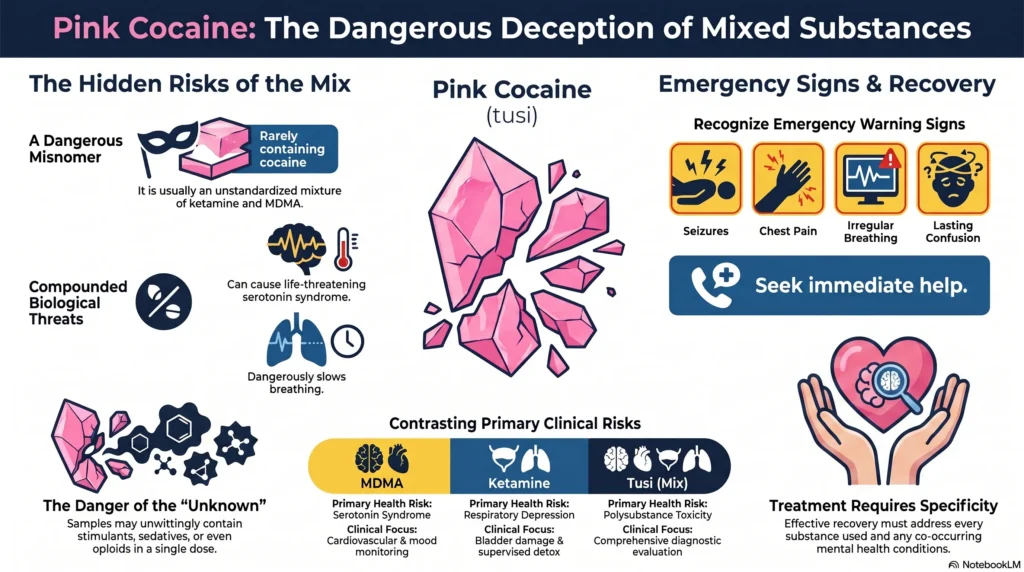
Pink cocaine rarely contains cocaine; it is usually an unstandardized mixture built around ketamine and MDMA.
MDMA behaves as a stimulant-empathogen; ketamine behaves as a dissociative anesthetic; a single name cannot tell you which effects to expect.
The Bay Area’s visible ketamine clinic scene can create a false sense of familiarity with a substance that behaves very differently outside a supervised setting.
Because composition is unpredictable and often polysubstance, treatment planning has to start with an honest, judgment-free look at everything someone actually used.
If you or a loved one is looking for residential care for addiction in the San Francisco Bay Area, Alta Mira Recovery Programs treats substance use disorders and complex co-occurring mental health conditions.
Our credentialed clinical team takes the time to understand you, providing diagnostic services and care tailored to your needs.
[1] Palamar, J.J., et al. 2026. Differentiating Intentional Ketamine Use From Unintentional Exposure as an Adulterant Using Oral Fluid Testing. Journal of Forensic Sciences.
[2] Drug Enforcement Administration. n.d. Pink Cocaine. U.S. Department of Justice.
[3] Fitzgerald, N.D., Abukahok, N., and Palamar, J.J. 2025. When Pink Powders Shift the Drug Landscape: Tusi (“Pink Cocaine”) and Other Colored Powders. International Journal of Drug Policy, 146.
[4] National Institute on Drug Abuse. n.d. MDMA (Ecstasy/Molly). U.S. Department of Health and Human Services.
[5] National Institute on Drug Abuse. n.d. Ketamine. U.S. Department of Health and Human Services.
[6] Esmaeilpour, F., Iderapalli, M., and Ugoh, E. 2025. Effective Management of Ketamine-Induced Bladder Syndrome With Baclofen During Ketamine Detoxification: A Case Report. BJPsych Open.
[7] Palamar, J.J., et al. 2025. Trends in Nonmedical Ketamine Use, Poisonings, Related Deaths, Pharmaceutical Diversions, and Law Enforcement Seizures. International Journal of Drug Policy.
