

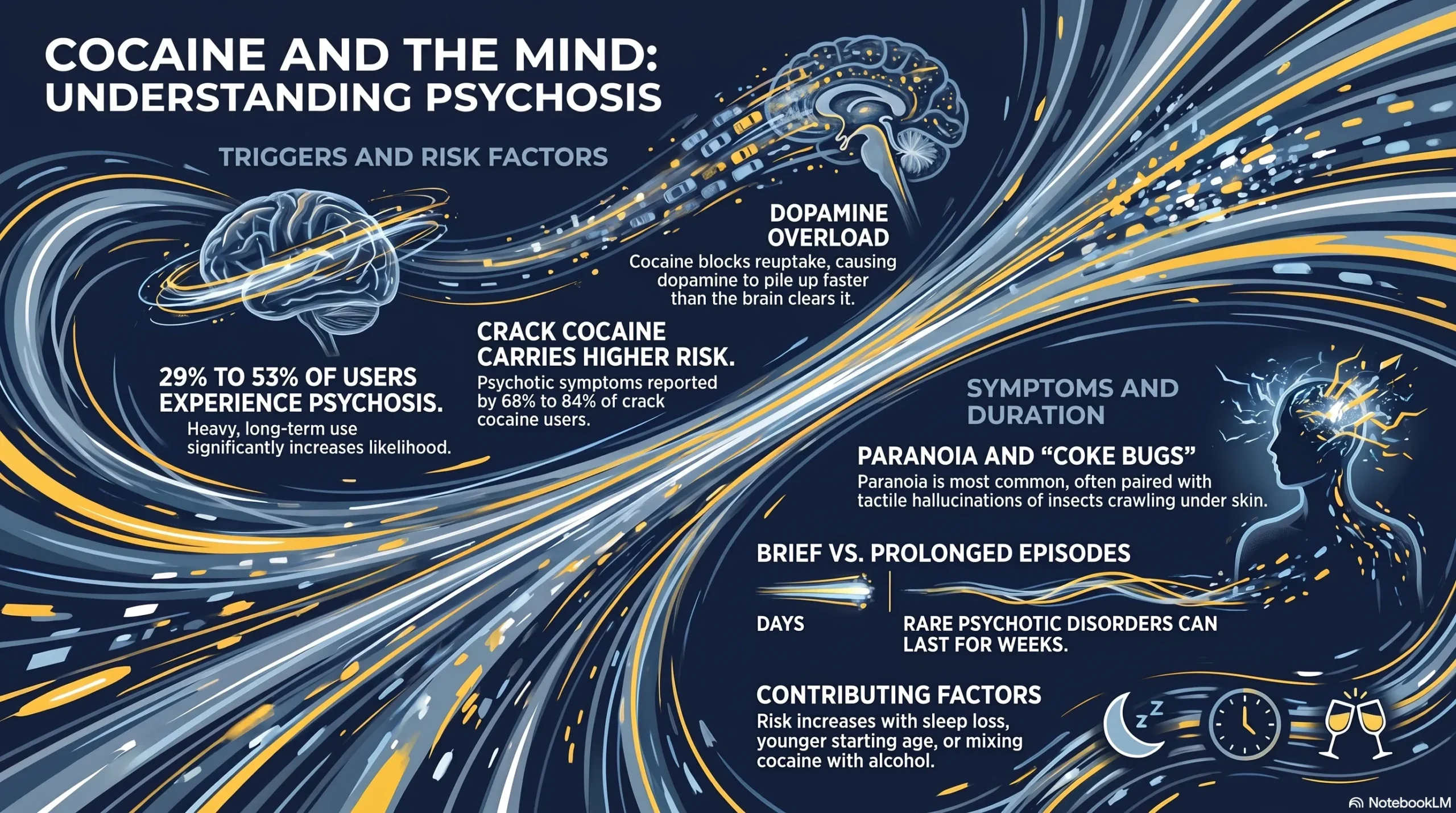
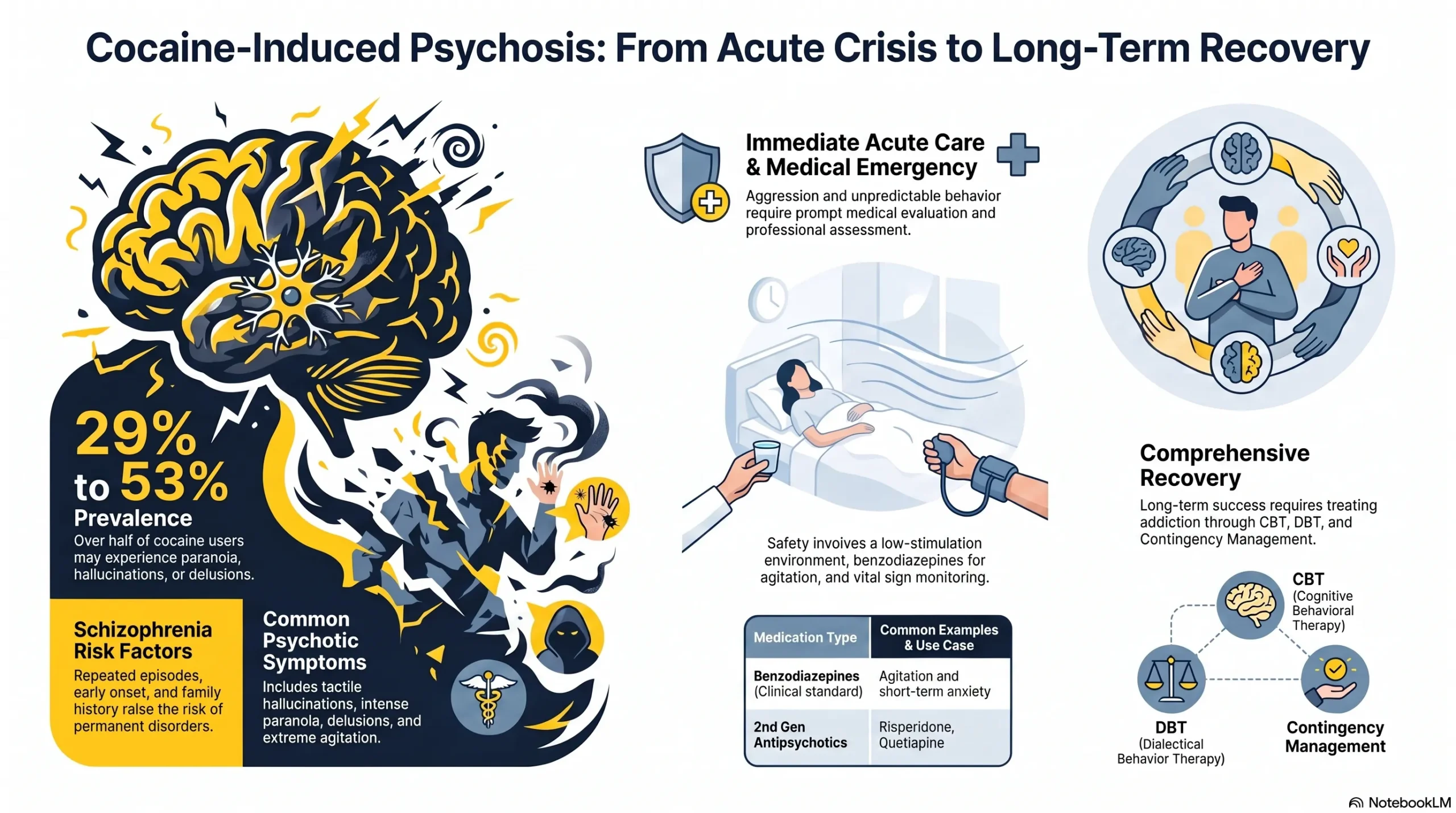
Cocaine floods the brain with dopamine, and for many users, that flood can tip into paranoia, hallucinations, or outright delusions. Between 29 and 53 percent of people who use cocaine experience these symptoms [1].
Cocaine was also tied to 21,945 overdose deaths in the United States in 2024, per the Centers for Disease Control and Prevention (CDC) data released in January 2026 [2].
Most psychotic episodes resolve once you stop using and get proper care.
Cocaine-induced psychosis is not one thing. Clinicians distinguish two types:
Cocaine blocks dopamine reuptake in the brain’s reward pathways, so the neurotransmitter piles up faster than the brain can clear it. That excess is what tips some users into psychosis [1].
The more cocaine someone uses, and the longer they use it, the higher the risk. Heavy, long-term users develop psychotic symptoms far more often than occasional users do [1].
The form matters too. Crack cocaine (cocaine that comes in the form of crystal-like rocks) reaches the brain faster than powder cocaine and causes a faster, more intense high sensation. In some samples, as many as 68 to 84 percent of crack cocaine users report having psychotic symptoms [1].
Personal history matters just as much as the drug itself. Factors that are linked to a greater likelihood of psychosis include:
Sleep loss raises the risk too, and so does mixing cocaine with alcohol or other drugs. Both increase the odds of psychotic symptoms, including tactile hallucinations [5].
 Can Cocaine Cause Psychosis After Just One Use?
Not for everyone, no. Psychosis is far more common with heavy or repeated use, but it does not require a long history — some people develop symptoms after limited exposure, especially with crack cocaine or an existing vulnerability such as a personality disorder [1][4].
The symptoms of cocaine-induced psychosis are varied. Paranoia shows up more than any other symptom. People feel suspicious of everyone around them, convinced they are being watched and certain someone means to hurt them [1].
Hallucinations take different forms — auditory, visual, and tactile. The tactile version has a name: formication, or “coke bugs,” which is the sensation of insects crawling under the skin. People scratch at it. Some scratch hard enough to break the skin open [5].
Delusions, agitation, and aggressive or erratic behavior can follow, too. All of it tends to get worse the more cocaine someone has used [1].
How long psychosis lasts depends on the type of psychosis. CIPS usually clears within hours to a few days after use stops. CIPD is rarer but can drag on for weeks, especially in people with a longer history of heavy use. CIPD is also more likely after prolonged or intravenous cocaine use [1].
Telling cocaine-induced psychosis apart from a primary disorder like schizophrenia is not simple. It takes a detailed history and a long stretch of clinical observation after cocaine use has stopped [3].
One study followed nearly 9.8 million people and found that among emergency department visits for substance use, 3.4% involved psychosis. People with repeated substance-induced episodes were far more likely to later develop a schizophrenia spectrum disorder [6].
Usually not — most symptoms resolve once cocaine leaves the body and the person stays abstinent. But repeated episodes, an early age of onset, and a family history of psychotic illness all raise the risk of developing schizophrenia, which is why ongoing psychiatric follow-up after stopping use matters [3][6].
Safety comes first. Clinicians move the person to a calm, low-stimulation environment and monitor vital signs and hydration while the acute symptoms burn off [7].
Benzodiazepines handle the agitation and anxiety short-term. If psychotic symptoms are severe or will not quit, clinicians add a second-generation antipsychotic — risperidone, quetiapine, or olanzapine — for a limited time [7][8].
Psychosis is a symptom, not the cause of addiction. Long-term recovery means treating what is underneath it: the cocaine use disorder and any co-occurring mental health conditions together.
Comprehensive care typically includes psychotherapies such as Cognitive Behavioral Therapy (CBT) and Dialectical Behavior Therapy (DBT), Medication Management for co-occurring conditions, and Contingency Management (CM).
 Is Cocaine-Induced Psychosis a Medical Emergency?
Yes. The risk of aggression, self-harm, and unpredictable behavior means it calls for prompt medical evaluation. Anyone showing signs of psychosis during or after cocaine use needs to be assessed by a medical professional as soon as possible.
If you or a loved one is looking for residential care for addiction in the San Francisco Bay Area, Alta Mira Recovery programs treat substance use disorders and complex co-occurring mental health conditions. Our credentialed clinical team provides diagnostic services and individualized care.
[1] Elsevier ScienceDirect. n.d. Cocaine-Induced Psychosis. ScienceDirect Topics.
[2] Garnett, M. F., and Miniño, A. M. 2026, Jan. Drug Overdose Deaths in the United States, 2023–2024. NCHS Data Brief, No. 549. National Center for Health Statistics.
[3] Fiorentini, A., et al. 2021. Substance-Induced Psychoses: An Updated Literature Review. Frontiers in Psychiatry, 12, Article 694863.
[4] Roncero, C., et al. 2014. Neuroticism Associated with Cocaine-Induced Psychosis in Cocaine-Dependent Patients: A Cross-Sectional Observational Study. PLOS ONE, 9(9), e106111.
[5] Patient Care Online. 2026, May 29. Drug-Induced Formication.
[6] Myran, D. T., et al. 2023. Transition to Schizophrenia Spectrum Disorder Following Emergency Department Visits Due to Substance Use With and Without Psychosis. JAMA Psychiatry, 80(11), 1169–1174.
[7] Palma-Álvarez, R. F., et al. 2019. Cocaine-Induced Psychosis and Asenapine as Treatment: A Case Study. Psychopharmacology Bulletin, 49(1), 92–97.
[8] Holstege, C. P. 2021. Cocaine-Related Psychiatric Disorders Medication. Medscape.
