
Alcohol addiction treatment works, yet most people who need it never get it. Only 7.6% of Americans with Alcohol Use Disorder (AUD) received any care in the past year, per 2026 federal data [1].
At Alta Mira Recovery Programs, treatment starts with medically supervised detox, then moves into a residential program shaped around each client’s assessment, history, and goals.
Alcohol Use Disorder (AUD) is a chronic medical condition. A person cannot reliably control their drinking, and so their tolerance rises and withdrawal follows once drinking stops. Nearly 28 million Americans aged 12 and older met the criteria for AUD in 2024 [2].
Recognizing a drinking problem can take years. By the time someone finally asks for help alcohol may have already cost them their health, a relationship, a job, or savings.
Residential care becomes the right call once physical dependence is present. If a person’s body has built tolerance to alcohol, detox needs medical supervision, and stopping at home is not a safe option.
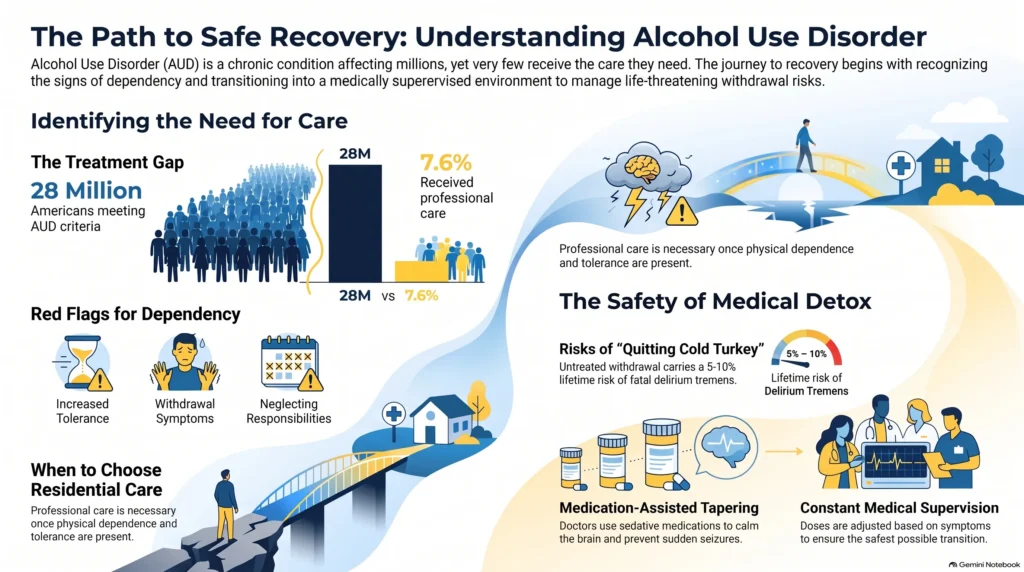
If two or three of these sound familiar, that is usually enough. A residential program that starts with medical evaluation and detox gives a person the structure and the safety that trying to quit alone does not.
As the brain works hard to adjust to a sudden absence of alcohol, some people develop seizures or delirium tremens, a severe state of confusion, and unstable vital signs [3].
That risk is common. People with AUD face a 5 to 10% lifetime risk of delirium tremens, and without treatment, the condition can be fatal [4].
Benzodiazepines, sedative medications used to manage withdrawal during detox, calm the brain the same way alcohol did, letting doctors taper someone off safely instead of a sudden drop.
The dose has to be adjusted constantly based on symptoms, which is why medical supervision, not the medication alone, is what makes detox work, and why detoxing alone is discouraged for anyone with a history of heavy drinking [3].
Without monitoring, early symptoms such as shaking, sweating, and anxiety can turn into seizures, hallucinations, or delirium tremens within days. Vital signs shift fast. Someone withdrawing alone has no reliable way to know how the situation will develop or to get help before it becomes an emergency.
At Alta Mira Recovery, treatment begins with a private, medically supervised detox, stabilization, and assessment phase. Clients are monitored around the clock by detox specialists who manage withdrawal symptoms, track vital signs, and keep clients safe and calm through the hardest part.
Detox/medical stabilization is achieved within an initial 30-day program. Once stabilized, clients move forward with their personalized treatment plan which includes group and individual therapy, family involvement, and holistic and experiential work such as yoga, mindfulness, personal training and expressive arts. Comprehensive psychiatric assessment may include neuropsychological testing to clarify diagnoses and further develop treatment plans.
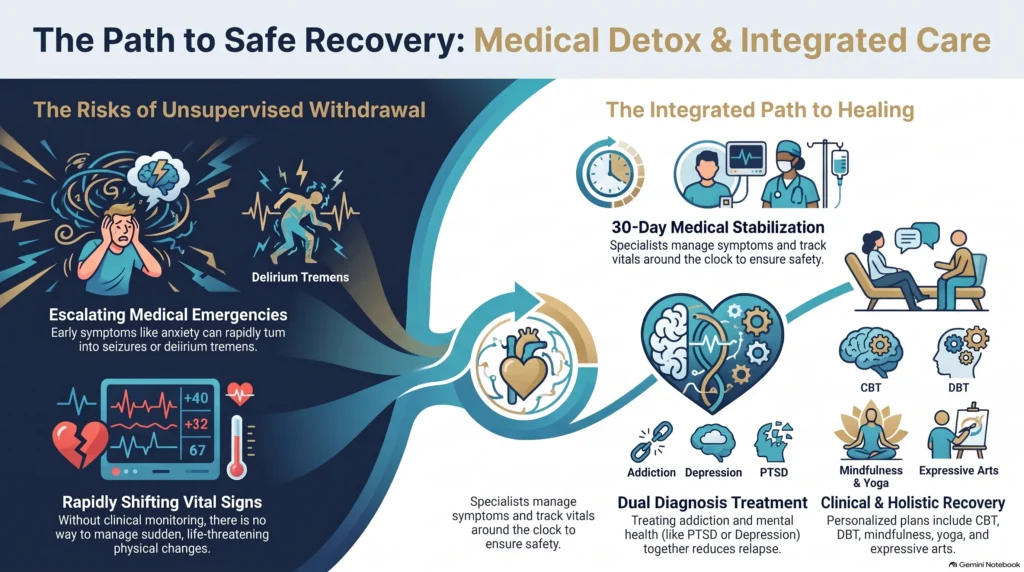
Alcohol Use Disorder rarely shows up alone. Depression, anxiety, Post-Traumatic Stress Disorder (PTSD), and bipolar disorder are among the conditions most often diagnosed alongside AUD, and clinical data keep showing how closely the two are linked.
Treat only the drinking and leave the underlying mood or trauma condition alone, and relapse becomes more likely. That is why Alta Mira’s clinicians screen for co-occurring conditions during the assessment phase.
Psychiatric care, medication management when it is warranted, Cognitive Behavioral Therapy (CBT), Dialectical Behavior Therapy (DBT), Motivational Enhancement and other approaches shape the treatment plan that follows.
Yes. It is standard practice. Clients with dual diagnosis get integrated care, so the substance use and the mental health condition(s) are treated together.
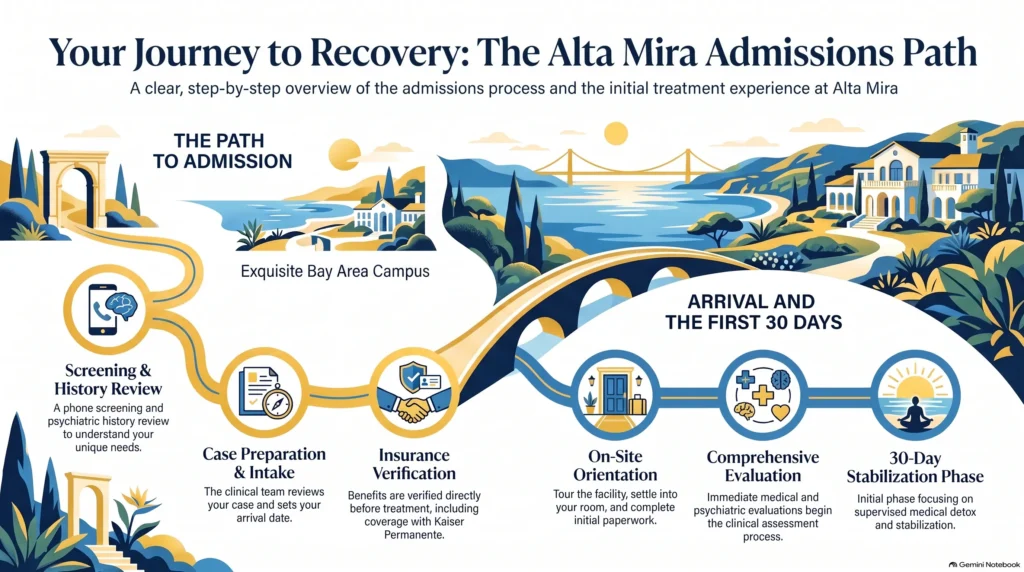
An admissions specialist walks you through the program and what to expect before, during, and after treatment.
Admissions moves through three stages:
On arrival, clients go over paperwork with their admissions specialist, tour the facility, and get time to settle into their room. Then comes the medical team for an initial evaluation, followed by a psychiatric evaluation as one of the first steps in our clinical assessment process.
Alta Mira accepts most major insurance plans, including in-network coverage with Kaiser Permanente. Benefits vary by plan, so the admissions team verifies coverage directly with each client before treatment starts.
If you or someone you love is struggling with alcohol addiction, Alta Mira Recovery Programs offers residential treatment for Alcohol and other Substance Use Disorders and complex co-occurring mental health conditions in a private Bay Area setting.
Our credentialed clinical team takes the time to understand you before recommending a course of care and builds the treatment plan around what your history shows, not a standardized track.
[1] National Institute on Alcohol Abuse and Alcoholism. 2026, Mar. Alcohol Treatment in the United States. U.S. Department of Health and Human Services.
[2] National Institute on Alcohol Abuse and Alcoholism. 2025, Aug. Alcohol Use Disorder (AUD) in the United States: Age Groups and Demographic Characteristics. U.S. Department of Health and Human Services.
[3] American Society of Addiction Medicine. 2020. The ASAM Clinical Practice Guideline on Alcohol Withdrawal Management. Journal of Addiction Medicine, 14(3 Suppl 1), 1-72.
[4] Toohey, S. 2021, Aug. Delirium Tremens (DTs). Medscape.
