Most insurance accepted. Click for details

The Alta Mira residential substance use disorder treatment programs were designed by renowned specialists who are among the best in their respective fields.


Executive Clinical Director
Concerta (methylphenidate) and Adderall (amphetamine mixed salts) are both Schedule II medications for Attention-Deficit/Hyperactivity Disorder (ADHD) with real addiction potential, but they do not attract the same people or get misused the same way.
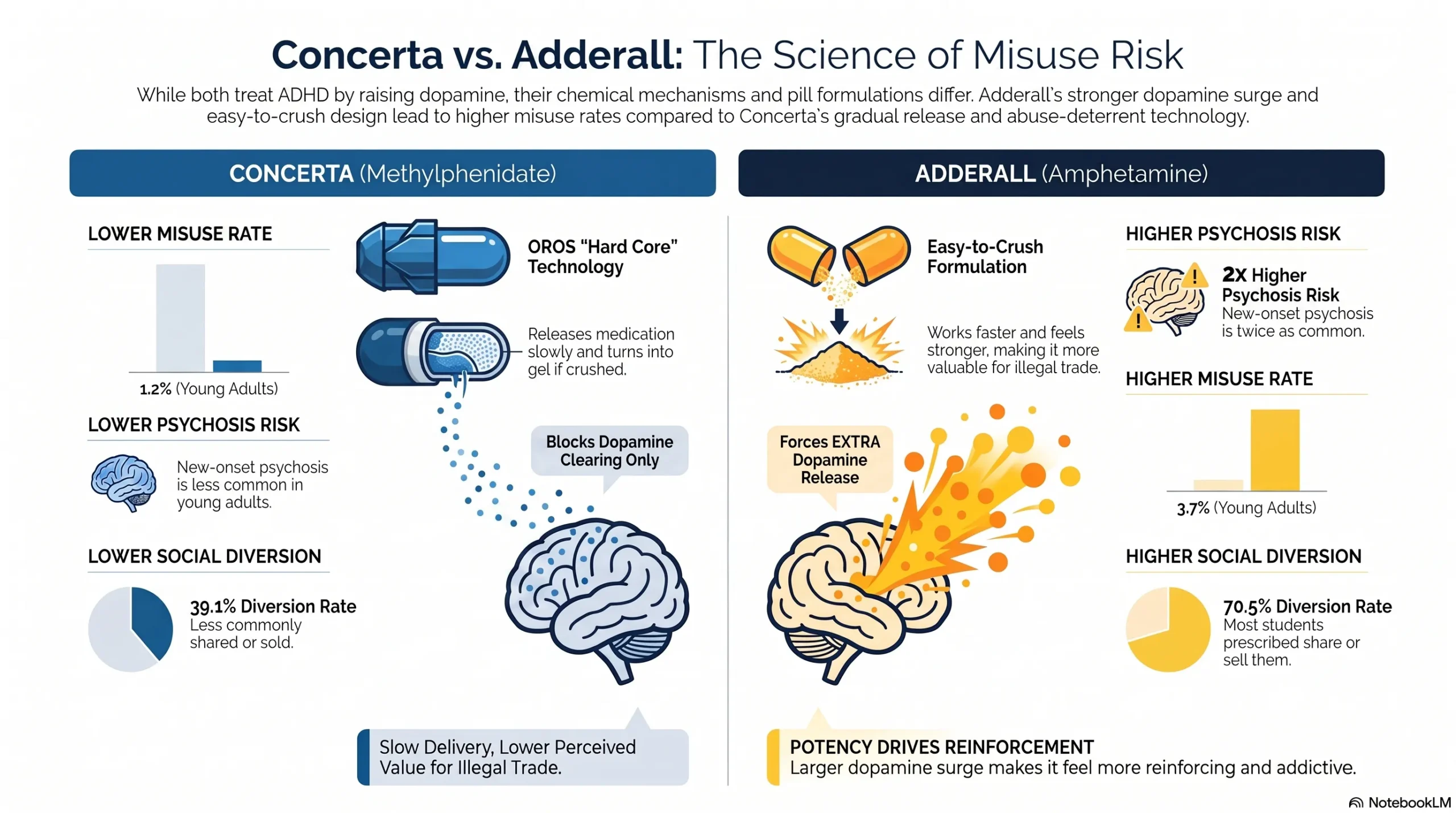
A 2026 review found that only about 1.2 percent of young adults misused methylphenidate in 2023, compared with 3.7 percent who misused amphetamine mixed salts [1]. The gap comes down to chemistry and formulation, not just which prescription pad it came from.
Methylphenidate and amphetamine are both Schedule II controlled substances that raise dopamine in the brain, but not in the same way. Methylphenidate blocks the transporters that normally clear dopamine away. Amphetamine also forces the nerve terminal to release additional dopamine [2].
That second mechanism produces a larger surge, which is why amphetamine tends to feel more reinforcing. Both drugs are controlled equally by law; the difference is in how strongly each one is felt, not how strictly either is regulated.
Speed matters as much as dose when it comes to stimulant misuse. When methylphenidate enters the body slowly, it raises dopamine gradually, and users rarely feel a high. When the same drug enters quickly, through snorting or injecting a crushed pill, for example, it produces a rush that oral tablets do not [2].
Concerta is engineered around this principle. Its Osmotic-Controlled Release Oral Delivery System (OROS) packs methylphenidate into a hard core that releases the drug slowly over about twelve hours. The same core also resists crushing, which closes off the fast-delivery route that makes misuse possible in the first place.
 Can Someone Get High From Concerta the Same Way They Do From Adderall?
Rarely. Researchers documented three teenagers who tried to snort crushed Concerta tablets. It did not work. Instead of breaking into a fine powder like a normal pill, the crushed tablet turned into a thick gel that trapped the drug inside, so there was nothing to snort [3].
Adderall does not have this kind of protection built in, so crushing it works the way people expect, which is one reason it gets misused this way more often.
Formulation is not the only thing separating these two groups of users. Among college students with a current stimulant prescription, those prescribed amphetamine or dextroamphetamine shared or sold their medication 70.5% of the time, compared with 39.1% for extended-release methylphenidate [4].
Concerta is also prescribed far more often to children and early adolescents, so its sharing or trading usually starts at home or school — with a sibling or classmate asking for a pill.
Adderall’s misuse story tends to start later, in college and early careers, among people deliberately seeking a performance or recreational effect.
Because it works faster and feels stronger. A pill with a quick, noticeable effect is simply worth more to trade or sell than one built to release slowly over half a day.
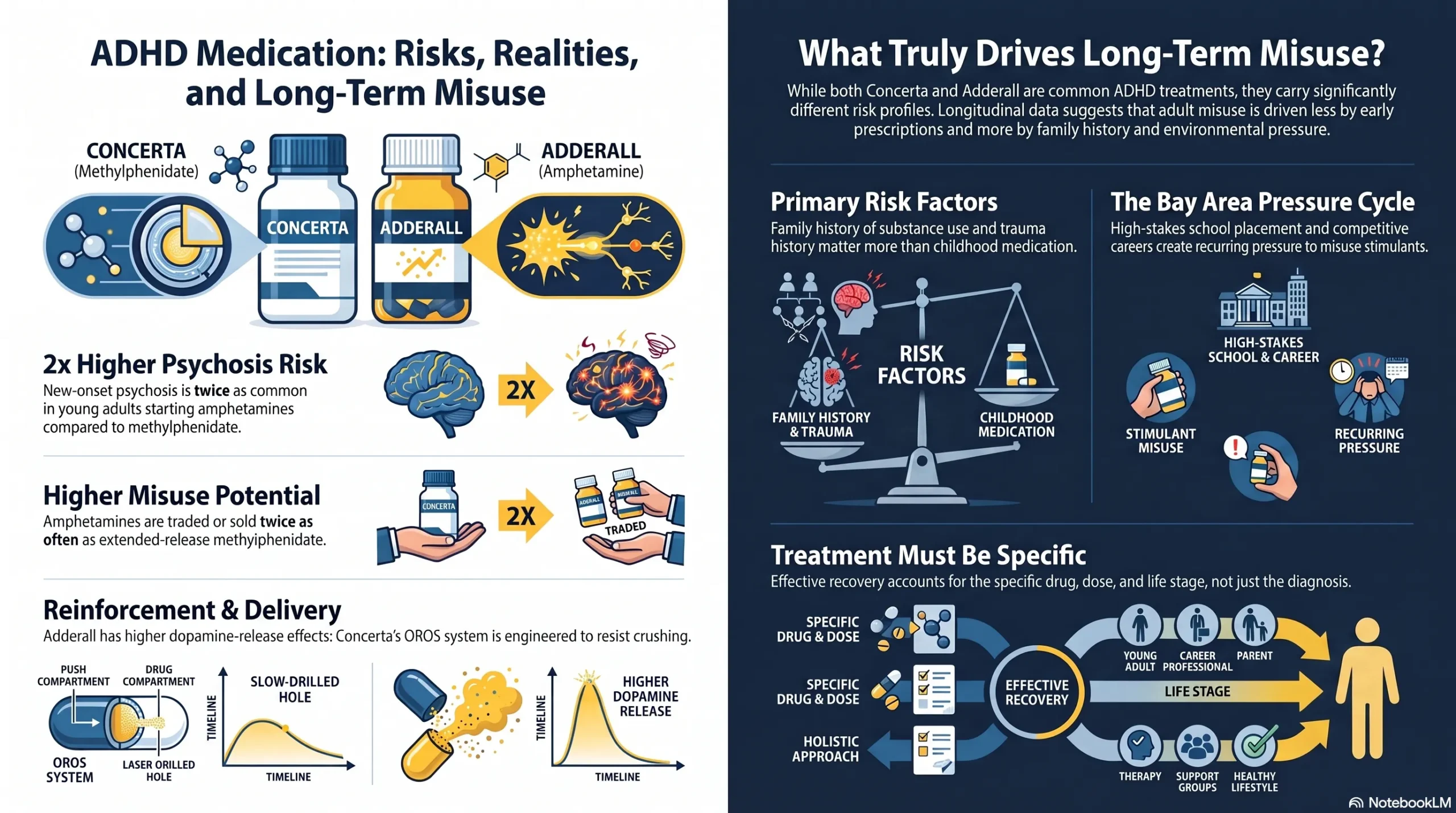
The two drugs also carry different psychiatric risks. In patients ages 13 to 25 who were newly starting a stimulant for ADHD, new-onset psychosis was about twice as common among those who started amphetamine compared with those who started methylphenidate [5]. The overall risk is low for both, but the same mechanism that makes amphetamine feel stronger also makes it riskier.
Many adults who misuse Adderall were treated for ADHD with a methylphenidate product like Concerta as children, which raises an obvious question: does early treatment set someone up for problems later?
A 17-year follow-up study found that the medication itself was not the deciding factor. Family history of substance use disorder, trauma history, and older age at first treatment mattered more than which drug a child started on [6].
The Bay Area’s competitive schools and workplaces put pressure on the same person at two different ages. A rigorous school placement often leads families to pursue an early ADHD evaluation, which is where a first prescription for something like Concerta typically begins.
Years later, the same pressure resurfaces in college admissions and early careers, and Adderall becomes the drug people reach for, sell, or share on their own. The chemistry has not changed — the pressure just moved to a new stage of life.
Someone whose stimulant history started with a Concerta prescription as a teenager is a different clinical picture than an adult who began crushing or overusing Adderall in their twenties, even if both eventually meet criteria for the same stimulant use disorder.
The first case often calls for family involvement and a fresh look at the original ADHD treatment plan. The second calls for a clear evaluation of undiagnosed ADHD versus non-medical use, informed by amphetamine’s higher reinforcing and psychiatric risk profile.
 What Matters Most
If you or a loved one is looking for residential care for stimulant addiction in the San Francisco Bay Area, Alta Mira Recovery Programs treats substance use disorders and complex co-occurring mental health conditions.
Our credentialed clinical team takes the time to understand you, providing diagnostic services and care tailored to your needs.
[1] Maglione, M.A., et al. 2026. Adult Misuse of ADHD Stimulant Medication in the United States: A Rapid Review. Journal of Clinical Psychopharmacology.
[2] Volkow, N.D. and Swanson, J.M. 2003. Variables That Affect the Clinical Use and Abuse of Methylphenidate in the Treatment of ADHD. American Journal of Psychiatry, 160(11), 1909-1918.
[3] Jaffe, S.L. 2002. Failed Attempts at Intranasal Abuse of Concerta. Journal of the American Academy of Child and Adolescent Psychiatry, 41(1), 5.
[4] Garnier, L.M., et al. 2010. Sharing and Selling of Prescription Medications in a College Student Sample. Journal of Clinical Psychiatry, 71(3), 262-269.
[5] Moran, L.V., et al. 2019. Psychosis with Methylphenidate or Amphetamine in Patients with ADHD. New England Journal of Medicine, 380(12), 1128-1138.
[6] Bommersbach, T.J., et al. 2025. Does Combined Stimulant and Psychosocial Treatment in Childhood Attention-Deficit/Hyperactivity Disorder Protect Against Future Substance Use?. JAACAP Open, 3(4), 1202-1212.