


Executive Clinical Director
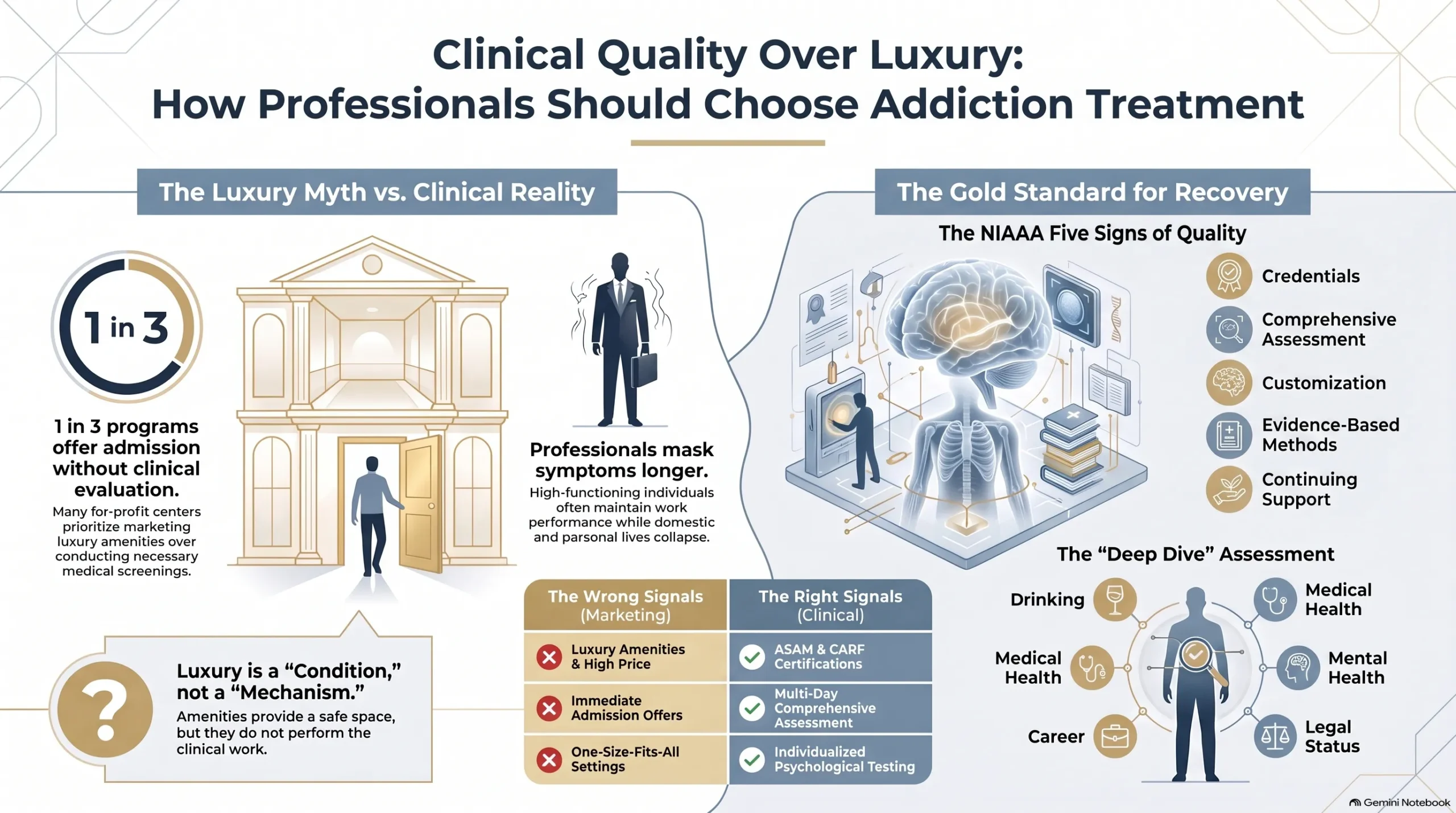
In a national audit of 368 residential addiction treatment programs in the United States, one in three offered admissions before any clinical evaluation, and the single most common recruitment tactic was the promotion of luxury amenities [1].
For a working professional comparing treatment options, those are the wrong signals to follow. What changes care outcomes is the depth of the assessment, the credentials of the people conducting treatment, and what happens after discharge.
The National Institute on Alcohol Abuse and Alcoholism (NIAAA) identifies five signs of higher-quality care:
Amenities do not appear on that list, and neither does price. Every item describes something a program does clinically, and every item is something a caller can ask about before committing to a program.
Non-clinical persuasion is routine. In that audit, 31% of for-profit programs promoted luxury amenities to callers who had not yet been clinically evaluated [1].
They matter as a condition rather than as a mechanism. A private, quiet setting protects discretion, provides a safe physical and emotional space, and makes hard clinical work more tolerable. The setting supports the treatment. It does not perform it.
Most people who need care never receive it. Among people aged 12 or older classified as needing substance use treatment in 2024, about one in five received any [3].
Professionals tend to arrive at care later still. High-functioning roles reward the ability to manage an impression, and that skill transfers: schedules get rearranged, symptoms get attributed to workload, and performance holds at work long after it has stopped holding at home.
The outward markers of a problem, such as missed work, financial collapse, and legal trouble, are the last things to fail when someone has income, structure, and a reputation to protect. By the time the call happens, the clinical picture is usually layered rather than simple.
Layered pictures are where assessment quality is even more important. Screening and full assessment are central to identifying co-occurring conditions, and most people with co-occurring substance use and mental disorders receive treatment for only one condition or no treatment at all [4].
According to NIAAA, a full assessment should cover drinking patterns, other substance use, general medical health, mental health, job status, housing, family and social support, and legal problems. A provider who asks only about alcohol and drug use has not conducted a comprehensive assessment [2].
At Alta Mira, clinicians participate from day one through an assessment process that integrates psychological, medical, and relational evaluations. Across the course of treatment, the team performs an extensive range of assessments, and that information feeds directly into the individualized treatment and medication plan.
Feedback sessions then walk the client through what the assessments have found, including the interpersonal patterns that inform more tailored treatment and stronger treatment outcomes.
Because the wrong explanation produces the wrong plan. Attention lapses, memory problems, and thinning frustration tolerance can come from substance effects, withdrawal, disrupted sleep, a mood or anxiety disorder, various forms of neurodivergence (including attention-deficit/hyperactivity disorder), trauma, or other mental health conditions. Distinguishing substance-induced presentations from independent mental conditions is a core assessment task [4].
As clinically indicated, Alta Mira Recovery incorporates onsite psychological testing for diagnostic clarity and treatment planning purposes. For someone whose career depends on cognitive performance, the difference between an accurate diagnosis and a plausible one is the whole treatment plan.
The American Society of Addiction Medicine (ASAM) Criteria is the standard set of decision rules for matching a person to a level of care. A multidimensional assessment across six dimensions identifies clinical needs.
Dimensional admission criteria then translate those needs into a recommended level of care, and the person is reassessed as treatment proceeds to determine whether to step up, step down, or to continue [5].
Alta Mira Recovery holds ASAM certification, which recognizes programs able to deliver evidence-based services consistent with national level-of-care guidelines and which was independently assessed by the Commission on Accreditation of Rehabilitation Facilities (CARF).
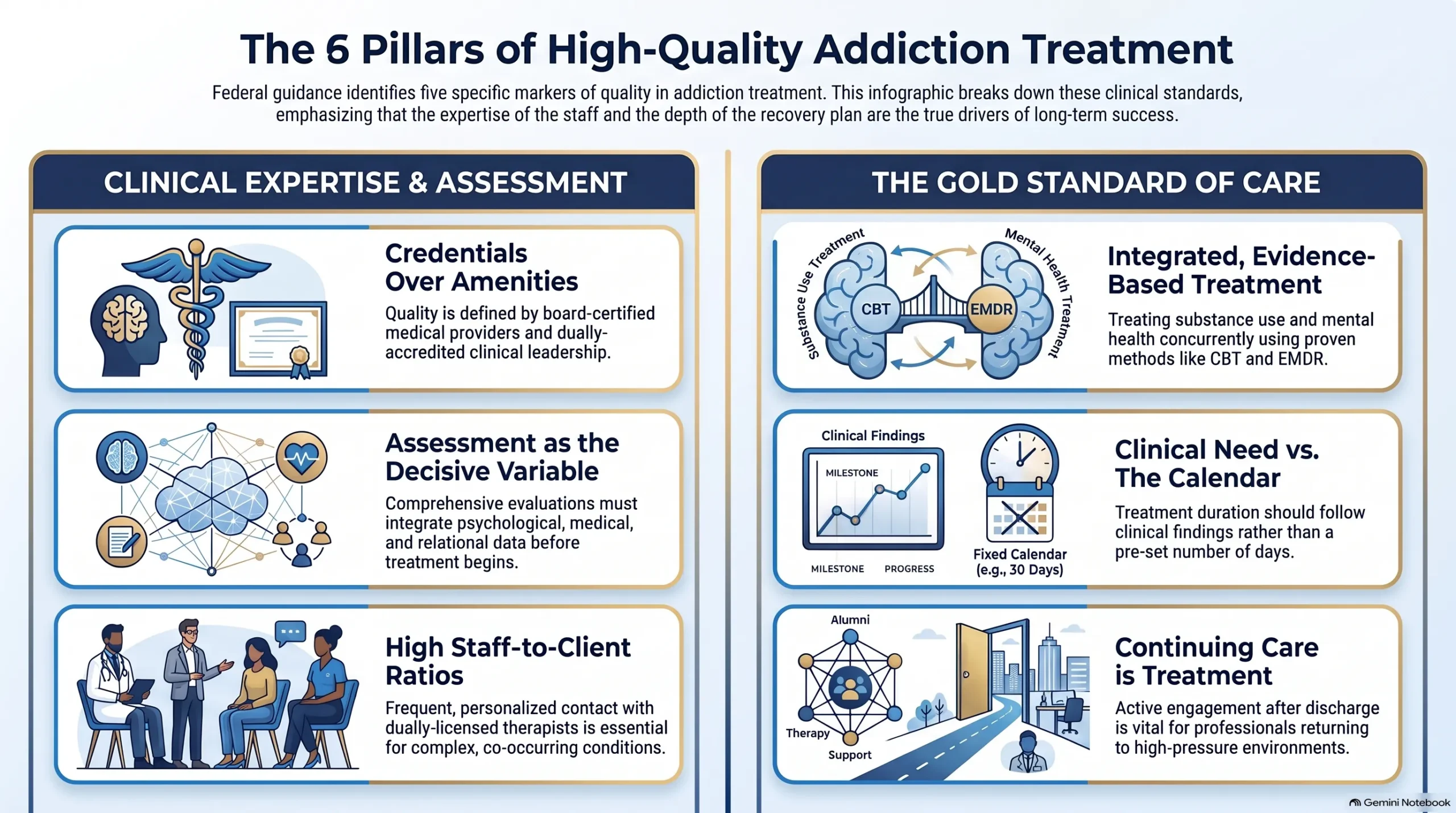
Credentials sit at the top of the NIAAA’s list of quality markers, and the point is that a program and the people inside it are considered together. What matters is current licensure and independent accreditation, counseling staff with advanced degrees, and medical providers who are board certified in addiction medicine or addiction psychiatry [2].
Alta Mira Recovery’s clinical leadership includes providers with board certification in addiction psychiatry, psychiatric nurse practitioners, primary therapists licensed at the masters or doctoral level, national experts in substance use disorders and co-occurring conditions, and a psychological assessment team. The staff-to-client ratio is set to allow frequent pre-scheduled and as-needed contact with all members of our teams.
Alta Mira is accredited by The Joint Commission, licensed by the California Department of Health Care Services to operate an adult residential alcohol and drug program treating co-occurring disorders, and a member of the National Association of Addiction Treatment Providers (NAATP).
Integrated care, in which substance use disorders and mental health disorders are addressed concurrently rather than sequentially or in separate systems, is the gold standard for treating co-occurring conditions [4].
Alta Mira Recovery’s programming is organized that way. Care can begin with medically supervised detox where physical dependence is present, moves through assessment and stabilization, and continues through the comprehensive residential program, with family programming and continuing care planned alongside it.
Among the approaches we use are Cognitive Behavioral Therapy (CBT), Dialectical Behavior Therapy (DBT), Motivational Enhancement, Acceptance and Commitment Therapy (ACT), Exposure and Response Prevention (ERP), Eye Movement Desensitization and Reprocessing (EMDR), and relapse prevention. Which ones a client receives follows from the assessment rather than from a “one size fits all” plan.
Length follows the clinical findings rather than a calendar. The appropriate duration depends on what the assessment finds, whether co-occurring conditions are present, and what continuing care will look like afterward. A program that quotes a firm number of days that looks the same for all clients before evaluating anything should be regarded as a red flag.
Continuing recovery support is the fifth sign of higher-quality care, and it is the one most easily promised and least often specified [2].
Research supports the efficacy of continuing care, and it points in a specific direction: continuing care of longer duration that includes active efforts to keep people engaged produces more consistently positive results [6].
A person’s clinical status can change over time, so continuing care needs built-in provisions to reassess regularly and adapt treatment when warranted [6]. Under the ASAM standards, transition and continued service criteria serve that function formally [5].
Because discharge returns the person to the environment that often shaped the problem: the same hours, the same pressure, the same colleagues. Alta Mira’s continuing care and alumni programming keep clinical contact in place through the transition back into daily life and work, instead of ending it at the door.
For those seeking a level of specialized, integrated care in the San Francisco Bay Area, Alta Mira Recovery is a high-end, top-tier residential addiction center specializing in the treatment of substance use disorders and complex co-occurring mental health issues.
Our team of addiction treatment professionals provides sophisticated clinical care and diagnostic services.
Sources
[1] Beetham, T., et al. 2021, Feb. Admission Practices and Cost of Care for Opioid Use Disorder at Residential Addiction Treatment Programs in the US. Health Affairs, 40(2), 317-325.
[2] National Institute on Alcohol Abuse and Alcoholism. n.d. Step 3 – Choose Quality Care. NIAAA Alcohol Treatment Navigator.
[3] Substance Abuse and Mental Health Services Administration. 2025, Jul. 28. SAMHSA Releases Annual National Survey on Drug Use and Health. Substance Abuse and Mental Health Services Administration.
[4] Substance Abuse and Mental Health Services Administration. 2020. Substance Use Disorder Treatment for People With Co-Occurring Disorders. Treatment Improvement Protocol (TIP) Series, No. 42. Substance Abuse and Mental Health Services Administration.
[5] American Society of Addiction Medicine. n.d. The ASAM Criteria Fourth Edition. American Society of Addiction Medicine.
[6] McKay, J. R. 2021. Impact of Continuing Care on Recovery From Substance Use Disorder. Alcohol Research: Current Reviews, 41(1), Article 01.