

Methamphetamine (“meth”) addiction is a chronic brain disease that needs professional treatment rather than willpower. It gravely damages users’ mental and physical well-being. A 2026 study of heart attacks in Northern California found that methamphetamine use was a factor in one in six cases [1].
Learn more about the impact of methamphetamine and why structured, evidence-based treatment is essential to recovery.
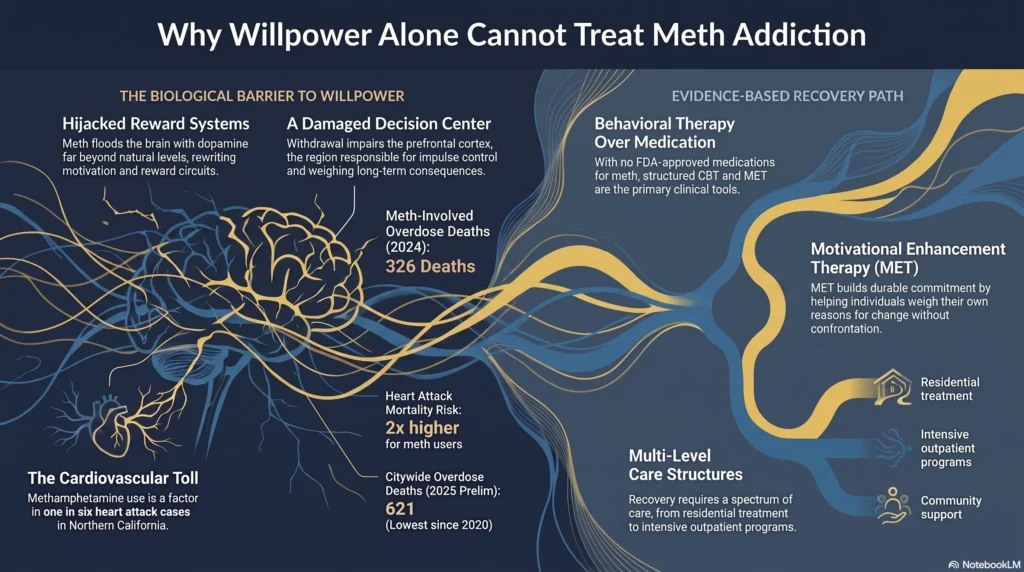
Methamphetamine increases dopamine levels in the brain, the neurotransmitter associated with motivation and reward, far above what any natural experience produces. Repeated exposure changes the functioning of the brain’s reward and decision-making circuits, which is one reason why Methamphetamine Use Disorder (MUD) has recently become a growing public health concern [2].
Research on methamphetamine withdrawal also points to disruptions in the prefrontal cortex, the brain region responsible for planning, impulse control, and weighing long-term consequences against short-term urges. Preclinical research has linked meth withdrawal to measurable deficits in these same circuits, deficits that can persist well after use stops [3].
This is part of why simply telling someone to stop using rarely works on its own. The brain systems we use to make and keep that decision are often the same systems methamphetamine has already impaired. In this case, recovery depends on structured support rather than effort or character alone.
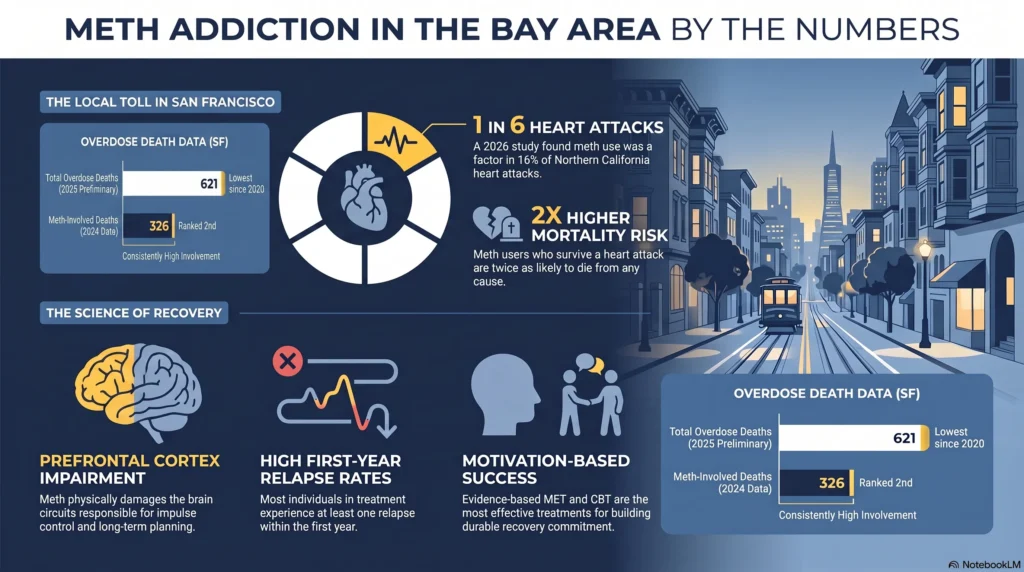
San Francisco’s own overdose data illustrates the local toll. The city recorded 326 methamphetamine-involved overdose deaths in 2024, second only to fentanyl, even as citywide overdose deaths fell to their lowest point in four years [4].
Preliminary figures for 2025 put total overdose deaths at 621, the lowest count since the city began tracking the crisis in 2020, though methamphetamine remains one of the substances most consistently involved [5].
The cardiovascular toll is just as striking: Meth users who suffered a heart attack were twice as likely to die from any cause. This risk remained even though these patients were younger and did not show any traditional risk factors [1].
Meth addiction typically follows a recognizable pattern, which helps explain why professional support matters at every stage [2][3].
| Stage | What Is Happening | Why Willpower Falls Short |
|---|---|---|
| First-time and repeated use | Dopamine surges make meth feel more rewarding than everyday routine. | The brain starts to prioritize meth over other natural rewards, including food, relationships, and any intellectual activity. |
| Escalation and tolerance | The brain produces less dopamine; brain receptors become less sensitive on their own. | Increased doses become necessary to feel bearably normal, not only to get high. |
| Dependence | Prefrontal cortex circuits — those in charge of planning and impulse control — are gradually deteriorating. | Decision-making and self-control are not just emotionally but physically strained. |
| Trying to quit | Cravings, low mood, and impaired concentration can last for weeks after last use. | Early discomfort can overwhelm resolve without medical and behavioral support. |
| Risk of relapse | Stress and environmental cues can reactivate reward pathways months or years later. | Lasting recovery depends on structured relapse prevention strategies, not a single decision. |
Currently, there is no medication approved by the U.S. Food and Drug Administration (FDA) specifically for MUD, so treatment relies on structured behavioral approaches rather than a one-size-fits-all prescription.
Effective meth treatment spans residential care, partial hospitalization (PHP), and intensive outpatient programs (IOP). This multi-level approach is necessary because addiction often overlaps with mental health conditions, requiring different levels of structure during recovery.
Most treatment plans are complete with Cognitive Behavioral Therapy (CBT) and Motivational Enhancement Therapy (MET) to help people identify triggers, build coping skills, and stay engaged with recovery after the initial urge to use has passed.
MET is a brief, client-centered approach that strengthens a person’s own motivation to change, rather than directing them toward it, so it works especially well for people who feel ambivalent about giving up meth.
Rather than confronting resistance, a clinician trained in MET helps the person weigh their own reasons for and against continued use, which tends to build more durable commitment than persuasion alone.
Together, CBT and MET address both practical skills and internal motivation, giving people the tools to manage cravings and the resolve to keep using these tools.
Meth addiction is a chronic, relapsing condition. Research shows that most people who engage in treatment still experience at least one relapse within the first year, though continued engagement lowers that risk over time [2].
Family support, stable housing, and ongoing therapy all play a role in sustaining recovery well beyond the initial treatment period, especially for people with co-occurring mental health conditions.
Meth addiction impacts the brain’s dopamine and prefrontal cortex systems, so willpower alone is rarely enough to sustain recovery.
The toll of methamphetamine on the Bay Area is evident in overdose data; meth is also linked to a higher rate of heart attacks.
MET and CBT are among the most effective treatments available for meth addiction.
Recovery from meth addiction is possible with structured, professional support. Reaching out to a recovery program is the most important step you can take.
For those seeking this level of specialized, integrated care in the San Francisco Bay area, Alta Mira Recovery is a high-end, top-tier residential addiction center specializing in the treatment of substance use disorders and complex co-occurring mental health issues.
Our addiction treatment experts provide professional clinical care and diagnostics in a manner that respects your unique situation and path toward recovery.
[1] Zhao, S. X., et al. 2026. Methamphetamine Use Among Adult Patients Presenting With Acute Coronary Syndrome: A Single-Center Retrospective Cohort Study. Journal of the American Heart Association, 15(9).
[2] Paulus, M. P., and Stewart, J. L. 2020. Methamphetamine Use Disorder: The Next Addiction Crisis. JAMA Psychiatry, 77(9), 959–966.
[3] Poorvii, R., et al. 2026. Cognitive Effects of Methamphetamine and Amphetamine Withdrawal in Rodents: A Systematic Review. Frontiers in Psychology, 17, Article 1729722.
[4] San Francisco Examiner. 2025, Jan. 17. SF in 2024 Records Fewest Drug-Overdose Deaths Since 2020.
Methamphetamine (“meth”) addiction is a chronic brain disease that needs professional treatment rather than willpower. It gravely damages users’ mental and physical well-being. A 2026 study of heart attacks in Northern California found that methamphetamine use was a factor in one in six cases [1].
Learn more about the impact of methamphetamine and why structured, evidence-based treatment is essential to recovery.
Methamphetamine increases dopamine levels in the brain, the neurotransmitter associated with motivation and reward, far above what any natural experience produces. Repeated exposure changes the functioning of the brain’s reward and decision-making circuits, which is one reason why Methamphetamine Use Disorder (MUD) has recently become a growing public health concern [2].
Research on methamphetamine withdrawal also points to disruptions in the prefrontal cortex, the brain region responsible for planning, impulse control, and weighing long-term consequences against short-term urges. Preclinical research has linked meth withdrawal to measurable deficits in these same circuits, deficits that can persist well after use stops [3].
This is part of why simply telling someone to stop using rarely works on its own. The brain systems we use to make and keep that decision are often the same systems methamphetamine has already impaired. In this case, recovery depends on structured support rather than effort or character alone.
San Francisco’s own overdose data illustrates the local toll. The city recorded 326 methamphetamine-involved overdose deaths in 2024, second only to fentanyl, even as citywide overdose deaths fell to their lowest point in four years [4].
Preliminary figures for 2025 put total overdose deaths at 621, the lowest count since the city began tracking the crisis in 2020, though methamphetamine remains one of the substances most consistently involved [5].
The cardiovascular toll is just as striking: Meth users who suffered a heart attack were twice as likely to die from any cause. This risk remained even though these patients were younger and did not show any traditional risk factors [1].
Meth addiction typically follows a recognizable pattern, which helps explain why professional support matters at every stage [2][3].
| Stage | What Is Happening | Why Willpower Falls Short |
|---|---|---|
| First-time and repeated use | Dopamine surges make meth feel more rewarding than everyday routine. | The brain starts to prioritize meth over other natural rewards, including food, relationships, and any intellectual activity. |
| Escalation and tolerance | The brain produces less dopamine; brain receptors become less sensitive on their own. | Increased doses become necessary to feel bearably normal, not only to get high. |
| Dependence | Prefrontal cortex circuits — those in charge of planning and impulse control — are gradually deteriorating. | Decision-making and self-control are not just emotionally but physically strained. |
| Trying to quit | Cravings, low mood, and impaired concentration can last for weeks after last use. | Early discomfort can overwhelm resolve without medical and behavioral support. |
| Risk of relapse | Stress and environmental cues can reactivate reward pathways months or years later. | Lasting recovery depends on structured relapse prevention strategies, not a single decision. |
Currently, there is no medication approved by the U.S. Food and Drug Administration (FDA) specifically for MUD, so treatment relies on structured behavioral approaches rather than a one-size-fits-all prescription.
Effective meth treatment spans residential care, partial hospitalization (PHP), and intensive outpatient programs (IOP). This multi-level approach is necessary because addiction often overlaps with mental health conditions, requiring different levels of structure during recovery.
Most treatment plans are complete with Cognitive Behavioral Therapy (CBT) and Motivational Enhancement Therapy (MET) to help people identify triggers, build coping skills, and stay engaged with recovery after the initial urge to use has passed.
MET is a brief, client-centered approach that strengthens a person’s own motivation to change, rather than directing them toward it, so it works especially well for people who feel ambivalent about giving up meth.
Rather than confronting resistance, a clinician trained in MET helps the person weigh their own reasons for and against continued use, which tends to build more durable commitment than persuasion alone.
Together, CBT and MET address both practical skills and internal motivation, giving people the tools to manage cravings and the resolve to keep using these tools.
Meth addiction is a chronic, relapsing condition. Research shows that most people who engage in treatment still experience at least one relapse within the first year, though continued engagement lowers that risk over time [2].
Family support, stable housing, and ongoing therapy all play a role in sustaining recovery well beyond the initial treatment period, especially for people with co-occurring mental health conditions.
Meth addiction impacts the brain’s dopamine and prefrontal cortex systems, so willpower alone is rarely enough to sustain recovery.
The toll of methamphetamine on the Bay Area is evident in overdose data; meth is also linked to a higher rate of heart attacks.
MET and CBT are among the most effective treatments available for meth addiction.
Recovery from meth addiction is possible with structured, professional support. Reaching out to a recovery program is the most important step you can take.
For those seeking this level of specialized, integrated care in the San Francisco Bay area, Alta Mira Recovery is a high-end, top-tier residential addiction center specializing in the treatment of substance use disorders and complex co-occurring mental health issues.
Our addiction treatment experts provide professional clinical care and diagnostics in a manner that respects your unique situation and path toward recovery.
[1] Zhao, S. X., et al. 2026. Methamphetamine Use Among Adult Patients Presenting With Acute Coronary Syndrome: A Single-Center Retrospective Cohort Study. Journal of the American Heart Association, 15(9).
[2] Paulus, M. P., and Stewart, J. L. 2020. Methamphetamine Use Disorder: The Next Addiction Crisis. JAMA Psychiatry, 77(9), 959–966.
[3] Poorvii, R., et al. 2026. Cognitive Effects of Methamphetamine and Amphetamine Withdrawal in Rodents: A Systematic Review. Frontiers in Psychology, 17, Article 1729722.
[4] San Francisco Examiner. 2025, Jan. 17. SF in 2024 Records Fewest Drug-Overdose Deaths Since 2020.
