

Phenibut is a synthetic analog of Gamma-Aminobutyric Acid (GABA) sold online as a calming nootropic supplement, yet it produces addiction and withdrawal that can resemble severe benzodiazepine withdrawal.
A January 2026 report to Congress from the U.S. Department of Health and Human Services flags phenibut, alongside kratom and tianeptine, as an emerging public health concern tracked through the National Poison Data System [1].
Phenibut slows the brain’s natural calming mechanism and leaves it dependent on the drug, which is why supervised medical rehabilitation works better than trying to quit alone.
Phenibut was developed in Russia in the 1960s as an anti-anxiety medication and has never been approved for any medical use in the United States. The Food and Drug Administration (FDA) has ruled that phenibut does not meet the legal definition of a dietary ingredient, which means any product labeled as a supplement while listing phenibut is misbranded [2].
Despite claims against manufacturers, phenibut remains easy to buy online under names such as “fenibut,” “Noofen,” and “PhGaba,” typically marketed for anxiety, sleep, and focus [2].
Because phenibut is not a controlled substance, it is legal to buy and possess, and it does not appear on routine urine drug screens. Phenibut use can go unnoticed by both the person taking it and the people around them, so a supplement bought for stress relief can quietly become addictive.
Phenibut produces a calming effect similar to alcohol or a benzodiazepine. With repeated use, the brain adjusts to the constant outside pressure and produces less of its own calming signal. The original dose stops working and higher amounts seem necessary just to feel normal.
A 2024 review of published phenibut withdrawal cases found an average dose of 13.6 grams a day, with a range stretching as high as 28.5 grams. Nearly three-quarters of patients had a prior history of alcohol or drug use [3].
Most people affected are adults ages 18 to 34, and three out of four are men [4].
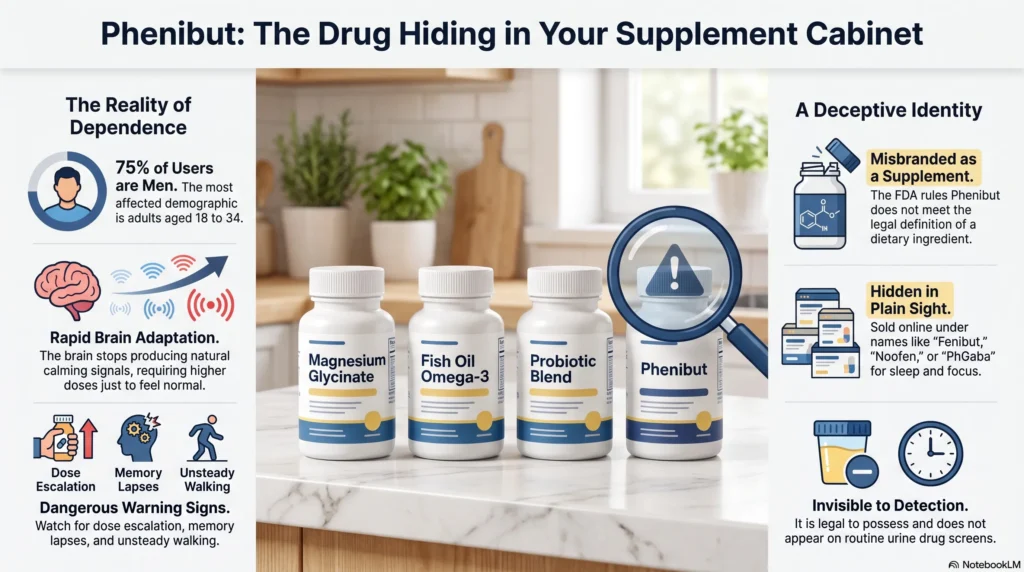
Phenibut addiction rarely announces itself the way an illicit drug might. Because it is sold as a supplement, many people do not connect worsening anxiety, irritability, or sleep problems between doses to the product itself.
A history of anxiety or depression was present in 60 percent of documented withdrawal cases, which suggests many people start using phenibut to self-treat symptoms that then become entangled with the substance itself [3].
Warning signs of an emerging phenibut-use disorder include:
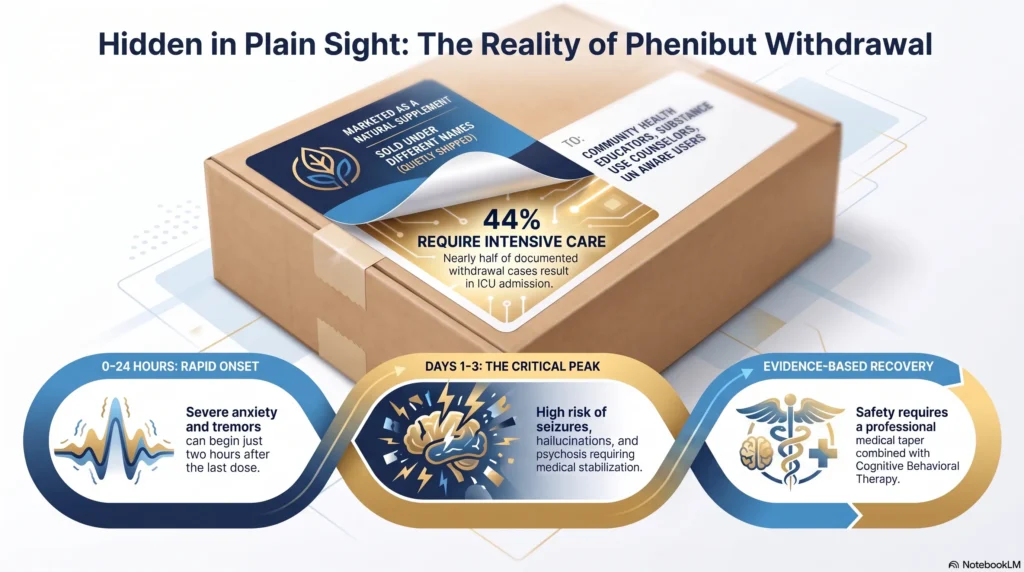
Because phenibut acts on the same receptors as benzodiazepines and alcohol, stopping it can trigger a similar withdrawal pattern, one that can begin within hours and escalate quickly without warning [3][5].
| Timeframe | What Typically Happens | Why It Is Risky |
|---|---|---|
| Within hours | Anxiety, tremor, sweating, and insomnia can begin within two hours of the last dose. | Symptoms often start before the person realizes they are withdrawing from anything, since phenibut is not recognized as a drug. |
| First 24 hours | Symptoms frequently intensify during this window rather than leveling off. | Nearly two-thirds of documented cases worsened within the first day of medical contact. |
| Days one to three | Agitation, hallucinations, as well as seizures or psychosis in more severe cases. | Roughly four in ten documented cases required intensive care during this peak period. |
| Days three and beyond | Anxiety, insomnia, and mood symptoms can linger for days to weeks after acute symptoms ease. | Without a supervised taper, returning to phenibut for relief becomes far more likely. |
A systematic review of documented phenibut withdrawal cases found seizures in 8 percent of patients, intubation in 24 percent, and admission to an intensive care unit in 44 percent [5].
Severity was similar whether phenibut was the only substance involved or was combined with alcohol or other drugs, so the presence of other substances does not reliably predict how dangerous a given withdrawal will be [5]. This is yet another reason why attempting a self-managed taper at home carries real risk.
Because no single medication has been studied in a controlled trial for phenibut withdrawal, treatment draws on the same tools used for benzodiazepine and alcohol withdrawal.
Across published cases, doctors have used benzodiazepines, baclofen, and phenobarbital, often in combination, to control withdrawal symptoms [6].
In one documented case, a baclofen taper resolved persistent withdrawal symptoms after standard approaches had failed [7].
Medical stabilization is only part of lasting recovery. Cognitive Behavioral Therapy (CBT) and Motivational Enhancement Therapy (MET) help address the anxiety or insomnia that often drove the original phenibut use, so the underlying issue does not resurface once the taper is complete.
For most individuals, a structured residential setting is the most effective way to provide this level of care, as it allows for medical monitoring and therapy to occur simultaneously.
Phenibut dependence responds well to the right combination of medical care and therapy, and that care is available close to home.
Alta Mira Recovery is a residential treatment center in the San Francisco Bay Area built around substance use disorders and the mental health conditions that often accompany them.
Every client’s care plan is shaped around their own history, not a standard template. Our clinical team has the experience to manage a withdrawal like this safely and provide comprehensive care through full recovery.
[1] U.S. Department of Health and Human Services. 2026, Jan. 23. Poison Control Centers Program: Report to Congress, 2023–2024. Health Resources and Services Administration.
[2] U.S. Food and Drug Administration. 2023, July 12. Phenibut in Dietary Supplements.
[3] Stewart, C., et al. 2024. A Systematic Review of Phenibut Withdrawals. Cureus, 16(9), Article e68775.
[4] Graves, J. M., et al. 2020. Notes From the Field: Phenibut Exposures Reported to Poison Centers — United States, 2009–2019. MMWR. Morbidity and Mortality Weekly Report, 69(35), 1227–1228.
[5] Feldman, R., et al. 2023. A Systematic Review of Phenibut Withdrawal Focusing on Complications, Therapeutic Approaches, and Single Substance Versus Polysubstance Withdrawal. Clinical Toxicology, 61(11), 941–951.
[6] Penzak, S. R., and Bulloch, M. 2024. Phenibut: Review and Pharmacologic Approaches to Treating Withdrawal. Journal of Clinical Pharmacology, 64(6), 652–671.
[7] Ahuja, T., et al. 2018. Phenibut (β-Phenyl-γ-Aminobutyric Acid) Dependence and Management of Withdrawal: Emerging Nootropics of Abuse. Case Reports in Psychiatry, 2018, Article 9864285.
Phenibut is a synthetic analog of Gamma-Aminobutyric Acid (GABA) sold online as a calming nootropic supplement, yet it produces addiction and withdrawal that can resemble severe benzodiazepine withdrawal.
A January 2026 report to Congress from the U.S. Department of Health and Human Services flags phenibut, alongside kratom and tianeptine, as an emerging public health concern tracked through the National Poison Data System [1].
Phenibut slows the brain’s natural calming mechanism and leaves it dependent on the drug, which is why supervised medical rehabilitation works better than trying to quit alone.
Phenibut was developed in Russia in the 1960s as an anti-anxiety medication and has never been approved for any medical use in the United States. The Food and Drug Administration (FDA) has ruled that phenibut does not meet the legal definition of a dietary ingredient, which means any product labeled as a supplement while listing phenibut is misbranded [2].
Despite claims against manufacturers, phenibut remains easy to buy online under names such as “fenibut,” “Noofen,” and “PhGaba,” typically marketed for anxiety, sleep, and focus [2].
Because phenibut is not a controlled substance, it is legal to buy and possess, and it does not appear on routine urine drug screens. Phenibut use can go unnoticed by both the person taking it and the people around them, so a supplement bought for stress relief can quietly become addictive.
Phenibut produces a calming effect similar to alcohol or a benzodiazepine. With repeated use, the brain adjusts to the constant outside pressure and produces less of its own calming signal. The original dose stops working and higher amounts seem necessary just to feel normal.
A 2024 review of published phenibut withdrawal cases found an average dose of 13.6 grams a day, with a range stretching as high as 28.5 grams. Nearly three-quarters of patients had a prior history of alcohol or drug use [3].
Most people affected are adults ages 18 to 34, and three out of four are men [4].
Phenibut addiction rarely announces itself the way an illicit drug might. Because it is sold as a supplement, many people do not connect worsening anxiety, irritability, or sleep problems between doses to the product itself.
A history of anxiety or depression was present in 60 percent of documented withdrawal cases, which suggests many people start using phenibut to self-treat symptoms that then become entangled with the substance itself [3].
Warning signs of an emerging phenibut-use disorder include:
Because phenibut acts on the same receptors as benzodiazepines and alcohol, stopping it can trigger a similar withdrawal pattern, one that can begin within hours and escalate quickly without warning [3][5].
| Timeframe | What Typically Happens | Why It Is Risky |
|---|---|---|
| Within hours | Anxiety, tremor, sweating, and insomnia can begin within two hours of the last dose. | Symptoms often start before the person realizes they are withdrawing from anything, since phenibut is not recognized as a drug. |
| First 24 hours | Symptoms frequently intensify during this window rather than leveling off. | Nearly two-thirds of documented cases worsened within the first day of medical contact. |
| Days one to three | Agitation, hallucinations, as well as seizures or psychosis in more severe cases. | Roughly four in ten documented cases required intensive care during this peak period. |
| Days three and beyond | Anxiety, insomnia, and mood symptoms can linger for days to weeks after acute symptoms ease. | Without a supervised taper, returning to phenibut for relief becomes far more likely. |
A systematic review of documented phenibut withdrawal cases found seizures in 8 percent of patients, intubation in 24 percent, and admission to an intensive care unit in 44 percent [5].
Severity was similar whether phenibut was the only substance involved or was combined with alcohol or other drugs, so the presence of other substances does not reliably predict how dangerous a given withdrawal will be [5]. This is yet another reason why attempting a self-managed taper at home carries real risk.
Because no single medication has been studied in a controlled trial for phenibut withdrawal, treatment draws on the same tools used for benzodiazepine and alcohol withdrawal.
Across published cases, doctors have used benzodiazepines, baclofen, and phenobarbital, often in combination, to control withdrawal symptoms [6].
In one documented case, a baclofen taper resolved persistent withdrawal symptoms after standard approaches had failed [7].
Medical stabilization is only part of lasting recovery. Cognitive Behavioral Therapy (CBT) and Motivational Enhancement Therapy (MET) help address the anxiety or insomnia that often drove the original phenibut use, so the underlying issue does not resurface once the taper is complete.
For most individuals, a structured residential setting is the most effective way to provide this level of care, as it allows for medical monitoring and therapy to occur simultaneously.
Phenibut dependence responds well to the right combination of medical care and therapy, and that care is available close to home.
Alta Mira Recovery is a residential treatment center in the San Francisco Bay Area built around substance use disorders and the mental health conditions that often accompany them.
Every client’s care plan is shaped around their own history, not a standard template. Our clinical team has the experience to manage a withdrawal like this safely and provide comprehensive care through full recovery.
[1] U.S. Department of Health and Human Services. 2026, Jan. 23. Poison Control Centers Program: Report to Congress, 2023–2024. Health Resources and Services Administration.
[2] U.S. Food and Drug Administration. 2023, July 12. Phenibut in Dietary Supplements.
[3] Stewart, C., et al. 2024. A Systematic Review of Phenibut Withdrawals. Cureus, 16(9), Article e68775.
[4] Graves, J. M., et al. 2020. Notes From the Field: Phenibut Exposures Reported to Poison Centers — United States, 2009–2019. MMWR. Morbidity and Mortality Weekly Report, 69(35), 1227–1228.
[5] Feldman, R., et al. 2023. A Systematic Review of Phenibut Withdrawal Focusing on Complications, Therapeutic Approaches, and Single Substance Versus Polysubstance Withdrawal. Clinical Toxicology, 61(11), 941–951.
[6] Penzak, S. R., and Bulloch, M. 2024. Phenibut: Review and Pharmacologic Approaches to Treating Withdrawal. Journal of Clinical Pharmacology, 64(6), 652–671.
[7] Ahuja, T., et al. 2018. Phenibut (β-Phenyl-γ-Aminobutyric Acid) Dependence and Management of Withdrawal: Emerging Nootropics of Abuse. Case Reports in Psychiatry, 2018, Article 9864285.
