


Executive Clinical Director
Benzodiazepine dependence can form from a prescription taken exactly as directed, often within weeks, and stopping without medical supervision can trigger seizures serious enough to require emergency care.
In 2026, researchers found that roughly four in ten American adults prescribed a benzodiazepine were also taking another central nervous system (CNS) depressant in the same year, a combination that raises the risk of dangerous interactions during withdrawal [1].
Residential treatment offers the supervision an at-home taper cannot provide.
Alprazolam (Xanax), lorazepam (Ativan), diazepam (Valium), and clonazepam (Klonopin) are some commonly prescribed benzodiazepines, a class of medications that are within the category of sedatives/anxiolytics and are prescribed for anxiety, insomnia, seizures, and alcohol withdrawal. They work by enhancing the effect of Gamma-Aminobutyric Acid (GABA), the brain’s primary calming neurotransmitter, which is why they bring fast relief.
That same mechanism is what makes them habit-forming. The U.S. Food and Drug Administration (FDA) has warned that physical dependence can develop when a benzodiazepine is taken steadily for several days to weeks, even when someone takes it on schedule and never exceeds the dose. Stopping abruptly or cutting the dose too quickly can bring on withdrawal reactions, including seizures, that are life-threatening [2].
Yes. Dependence is a predictable, physical adaptation, not a sign that someone misused their medication. National prescribing data from 2026 shows that benzodiazepines are prescribed for anxiety or stress in a majority of cases across every adult age group, which means most people taking one started for a legitimate medical reason [1].
Physical dependence and a Sedative/Anxiolytic Use Disorder are not the same thing, and confusing the two can delay someone from getting the right kind of help. Nearly everyone who takes a benzodiazepine daily for more than a month will develop some physical dependence, while only an estimated 1.5% of people treated with these medications go on to develop a full use disorder [3].
The distinction matters for treatment planning. Dependence alone generally calls for a carefully managed taper, so it does not need the same intensity of care as a use disorder complicated by cravings and loss of control.
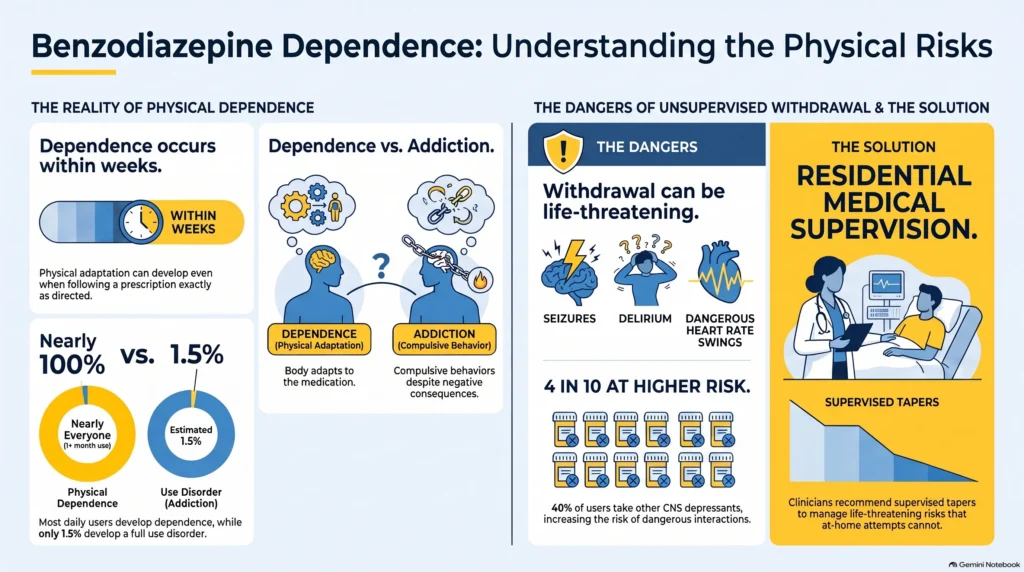
Not necessarily. Dependence means the body has adapted to the medication and will react if it is removed too quickly. Addiction, or a use disorder, adds behavioral components, among which is compulsive use that continues despite negative consequences.
A person can be dependent without meeting the criteria for a use disorder, and both situations deserve care, but the plan for each looks different [3].
Benzodiazepine withdrawal sits in a small category of substance withdrawal syndromes that can turn life-threatening without medical management, a category it shares mainly with alcohol [4]. Suddenly stopping, or cutting a dose faster than the body can adjust, can bring on seizures, delirium, and dangerous swings in heart rate and blood pressure.
The FDA’s boxed warning on benzodiazepines exists precisely because these withdrawal reactions are not rare edge cases. They are a documented risk across the entire drug class, common enough that the agency required every benzodiazepine label to carry the same warning [2].
Yes, in certain circumstances. A withdrawal seizure can be the first visible sign that something has gone wrong, and it can happen with little warning once a dose is lowered too quickly or stopped outright.
This is the central reason clinicians recommend against tapering off a benzodiazepine without supervision, regardless of how confident someone feels about managing it alone [2][4].
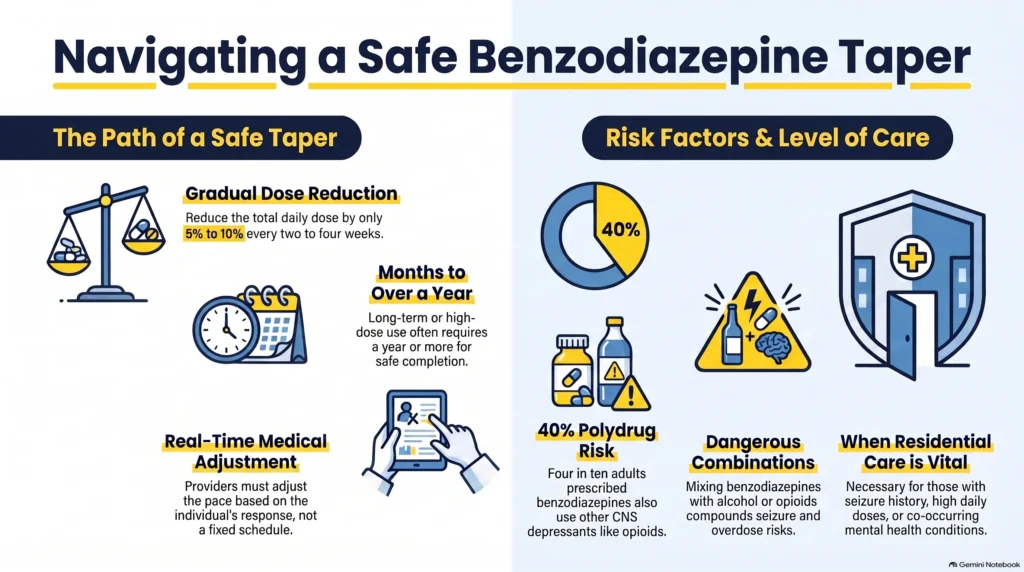
A safe taper is slow by design. For example, clinical guidance may recommend reducing the total daily dose by 5 to 10% every two to four weeks, then adjusting that pace based on how the individual responds, rather than following a fixed schedule [3].
For some people, especially after years of daily use, the full process can take as long as a year or more, with pauses along the way to let the body catch up. Withdrawal symptoms can also persist well after the last dose, a pattern known as protracted withdrawal, so the taper is only part of a longer recovery timeline [3].
It depends on the dose, the length of use, and how the individual responds along the way, but weeks to months is typical, and over a year is not unusual for long-term, high-dose use. There is no standard timeline that fits everyone, which is exactly why the pace needs a medical provider adjusting it in real time, not a printed schedule followed at home [3].
Outpatient tapering works for many people, but clinical guidelines direct patients experiencing severe or complicated withdrawal into an inpatient or residential setting where vital signs can be monitored around the clock and seizure risk can be assessed continuously [5].
A residential setting also removes the guesswork. The medication that started the dependence is usually still treating a real underlying condition, whether that is anxiety, insomnia, or a co-occurring mental health diagnosis, and that condition needs its own treatment plan alongside the taper, not just a withdrawal schedule.
Residential care becomes the safer option when someone has a history of withdrawal seizures, is also dependent on alcohol or another substance, has a high daily dose or has used for many years, or has a co-occurring mental health condition that outpatient monitoring cannot adequately track. A thorough evaluation, not a guess, is what determines the right level of care [5].
Benzodiazepines are rarely the only medication in the picture. National data shows that about four in ten adults prescribed a benzodiazepine were also prescribed another CNS depressant, such as an opioid, in the same year, and that share climbs higher among adults with serious psychological distress or poor general health [1].
Mixing benzodiazepines with alcohol, opioids, or other sedatives compounds the risk in both directions. It raises the danger of overdose while the person is using, and it complicates withdrawal once they stop, since more than one substance may need to be tapered or managed at the same time.
Yes. Alcohol, opioids, and benzodiazepines all slow the central nervous system, and combining them raises the risk of dangerously slowed breathing, sedation, and overdose. An accurate account of everything someone has been taking, not only the benzodiazepine, is essential to building a taper that is actually safe [1][2].
If you or a loved one is struggling to stop taking a benzodiazepine safely, Alta Mira Recovery Programs treats substance use disorders and complex co-occurring mental health conditions in the San Francisco Bay Area through a medically supervised detox.
Our credentialed clinical team takes the time to understand you, providing diagnostic services and care tailored to your needs.
[1] Olfson, M., et al. 2026. Trends in Benzodiazepine Prescribing to Adults in the United States: Results From the Medical Expenditure Panel Survey. Journal of Clinical Psychiatry, 87(1), Article 25m16125.
[2] U.S. Food and Drug Administration. 2020, Sept. 23. FDA Requiring Boxed Warning Updated to Improve Safe Use of Benzodiazepine Drug Class. U.S. Department of Health and Human Services.
[3] Zgierska, A.E., et al. 2025, May. Supporting Patients Through Benzodiazepine Tapering: A New Joint Clinical Practice Guideline. Journal of General Internal Medicine, 40(12), 2811-2813.
[4] Regina, A.C., et al. 2024. Withdrawal Syndromes. StatPearls. National Library of Medicine.
[5] American Society of Addiction Medicine. 2025. Benzodiazepine Tapering.