


Executive Clinical Director
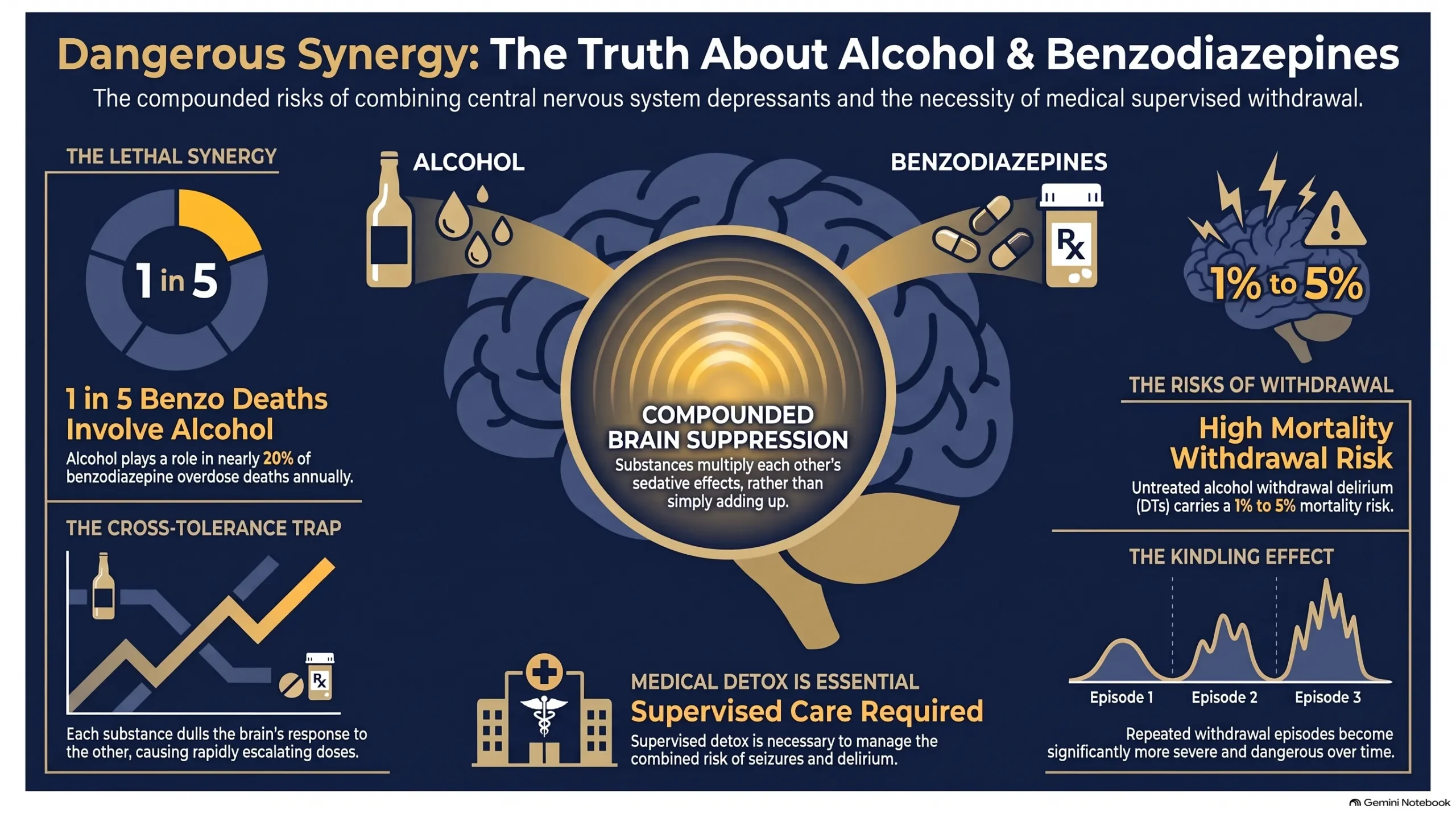
to one in five benzodiazepine overdose deaths each year, and the two substances suppress the same brain circuits even more when used together [1].
Many people who combine them started with a prescription or with drinking that quietly outpaced it. Understanding why this pairing traps people in escalating dependence and what a medically supervised detox looks like is the first step toward getting out safely.
Benzodiazepines are commonly prescribed for anxiety, panic, or insomnia, and patients with Alcohol Use Disorder (AUD) are twice as likely to receive a prescription [1]. The drinking often continues quietly alongside the medication.
Some people begin drinking heavily first and start a benzodiazepine later, whether prescribed or obtained another way, to manage the shakes or anxiety that heavy drinking produces. Others are introduced to benzodiazepines during a previous alcohol detox and never fully taper off.
No. Even at therapeutic doses, alcohol and benzodiazepines produce additive effects on the central nervous system [1].
There is no dose of either substance that makes combining them safe, which is why patients prescribed a benzodiazepine should be counseled specifically about alcohol, not simply told to use caution.
Alcohol and benzodiazepines both act on gamma-aminobutyric acid (GABA) receptors, the brain’s primary inhibitory system. Used together, the sedative and respiratory-depressant effects do not simply add up, they compound [1]. This is why overdoses can occur at doses of each substance that would be safe on their own.
Alcohol also inhibits how the body clears several benzodiazepines, including alprazolam, clonazepam, and diazepam, though not lorazepam, which keeps blood levels elevated longer than expected [1].
The combination is also a well-documented contributor to memory blackouts [1]. In 2023 alone, benzodiazepines were involved in nearly 11,000 overdose deaths in the United States [2].
Warning signs include a person who cannot be woken, breathing that is slow, shallow, or irregular, blue or gray lips or fingertips, and a limp, unresponsive body. Any of these signs is a medical emergency. Call 911 rather than waiting to see if the person sleeps it off.
Because alcohol and benzodiazepines act on the same receptor system, sustained exposure to either one leads the brain to downregulate its own inhibitory signaling [3].
The practical result is cross-tolerance: heavier drinking dulls the brain’s response to a benzodiazepine, and regular benzodiazepine use dulls its response to alcohol. The dose needed to feel normal keeps climbing on both fronts at once.
Yes, especially when the benzodiazepine started as a legitimate prescription. Among people who take benzodiazepines for longer than six months, an estimated 40% experience moderate to severe withdrawal symptoms if they stop [3].
Many do not recognize how physically dependent they have become until they try to cut back and cannot.
Alcohol withdrawal and benzodiazepine withdrawal are each capable of producing seizures and delirium on their own. Untreated alcohol withdrawal delirium, commonly known as delirium tremens, carries a 1 to 5% mortality risk [3]. Repeated withdrawal episodes tend to become more severe over time, a phenomenon known as kindling [3].
Attempting to withdraw from both substances at once without medical support combines these risks rather than dividing them. This is why medically supervised detox is recommended rather than stopping on one’s own, particularly for anyone with a history of heavy or prolonged use of both substances [4].
Benzodiazepine withdrawal can also cause seizures and, in severe cases, death, though morbidity and mortality rates tend to run lower than for alcohol withdrawal alone [3].
Combined with alcohol dependence, that risk profile changes, which is a primary reason both substances need to be assessed and managed together.
Detox begins with assessment, using tools such as the Clinical Institute Withdrawal Assessment for Alcohol, Revised (CIWA-Ar), to gauge how severe a withdrawal is likely to become before symptoms escalate [4].
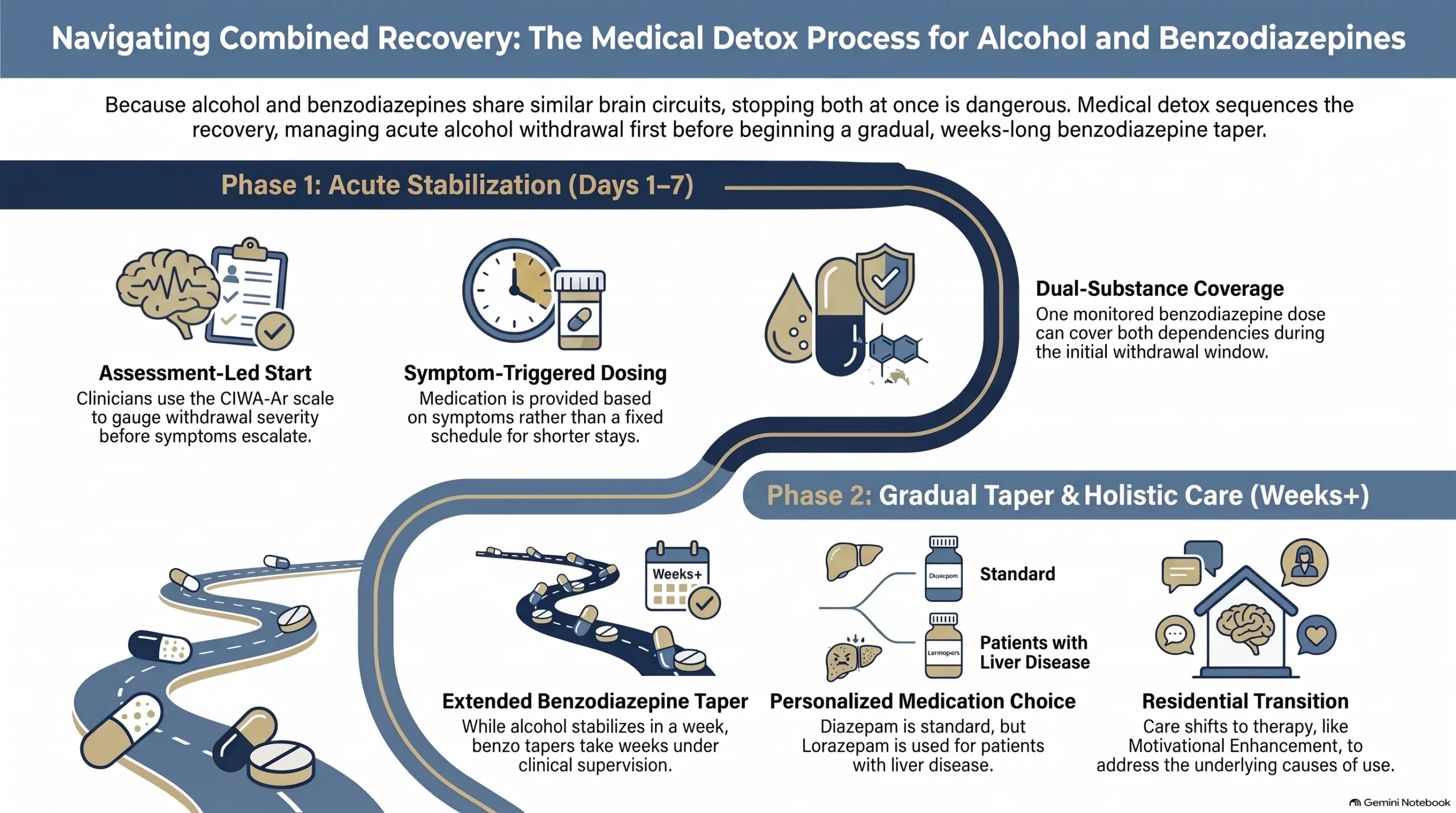
Symptom-triggered benzodiazepine dosing, rather than a fixed schedule, is the preferred approach, since it is associated with lower total medication use and a shorter length of stay [4].
Because alcohol and benzodiazepines share the same receptor mechanism, a benzodiazepine used to manage alcohol withdrawal can, at an appropriately monitored dose, also cover a person’s benzodiazepine dependence during the same window [3].
Diazepam is often preferred for how it moves through the body, though lorazepam may be the better choice for a patient with liver disease, since alcohol does not slow its clearance the way it does other benzodiazepines [1][3].
Once acute alcohol withdrawal has resolved, the benzodiazepine taper continues on its own timeline, gradually and under continued clinical supervision [5].
Acute alcohol withdrawal typically resolves within about a week under medical care. The benzodiazepine taper that follows usually takes considerably longer, often weeks, with the pace set by how the individual tolerates each reduction [5].
Detox stabilizes the body, but it does not address why someone leaned on both substances in the first place.
At Alta Mira, care continues into residential treatment built around each person’s history, often including Motivational Enhancement to work through ambivalence about change, alongside treatment for the co-occurring conditions that alcohol and benzodiazepines were being used to manage.
If you or someone you love has become dependent on both alcohol and a benzodiazepine, Alta Mira Recovery offers medically supervised detox and residential treatment for co-occurring substance dependence and complex mental health conditions in a private Bay Area setting.
Our credentialed clinical team assesses both substances together before designing a taper, and builds the treatment plan around your specific needs.
Contact our admissions team to learn more.
[1] National Institute on Alcohol Abuse and Alcoholism. 2025. Alcohol-Medication Interactions: Potentially Dangerous Mixes. Core Resource on Alcohol.
[2] National Institute on Drug Abuse. 2024, Aug. 21. Drug Overdose Deaths: Facts and Figures. U.S. Department of Health and Human Services.
[3] Regina et al. 2024. Withdrawal Syndromes. StatPearls Publishing.
[4] American Society of Addiction Medicine. 2020. The ASAM Clinical Practice Guideline on Alcohol Withdrawal Management. Journal of Addiction Medicine, 14(3S Suppl), 1-72.
[5] American Society of Addiction Medicine. 2025. The Joint Clinical Practice Guideline on Benzodiazepine Tapering: Considerations When Benzodiazepine Risks Outweigh Benefits. Journal of General Internal Medicine.