Most insurance accepted. Click for details

The Alta Mira residential substance use disorder treatment programs were designed by renowned specialists who are among the best in their respective fields.

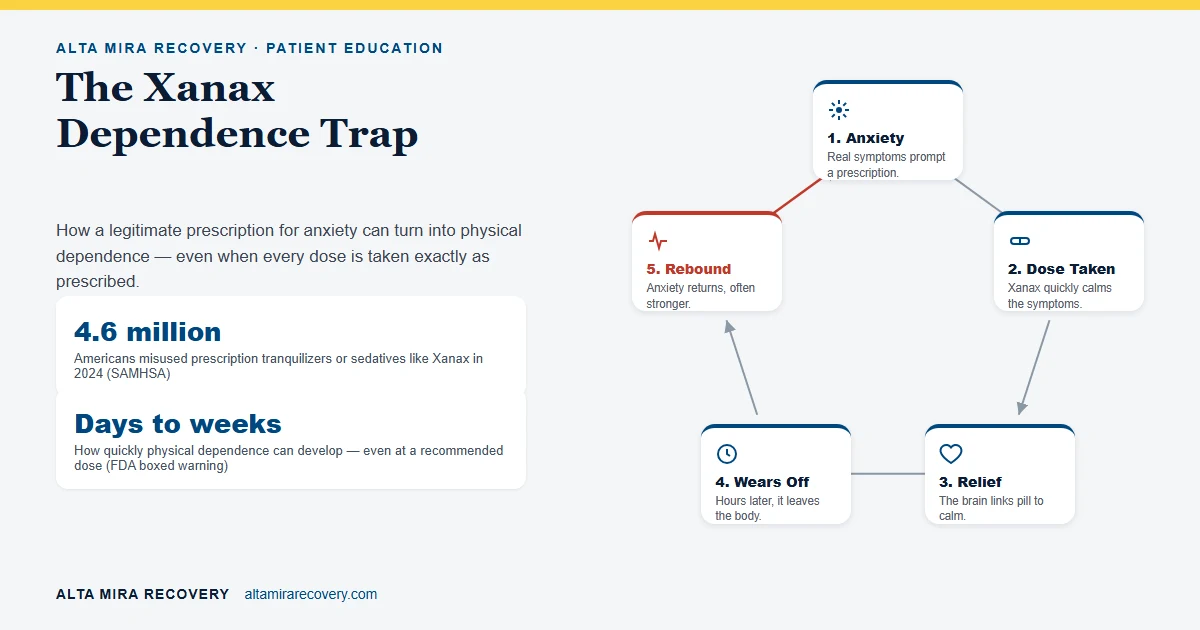
In 2024, an estimated 4.6 million people in the United States misused prescription tranquilizers or sedatives, the group of medications that includes benzodiazepines such as Xanax. 2.1 million people had a use disorder involving this group of drugs [1].
Many people begin taking the medication through a legitimate prescription to manage anxiety, and at first feel real relief. Over time, complications can develop that become more difficult to live with than the anxiety they first sought to treat.
Xanax is the brand name for alprazolam. It is approved for anxiety disorder, short-term relief of anxiety symptoms, and panic disorder, and its own label notes that everyday stress and tension usually do not call for an anti-anxiety medication [2].
Clinical guidelines generally recommend against taking benzodiazepines for more than 4 weeks, yet long-term use is common. The longer someone takes Xanax, the more tolerance develops, while the risks associated with use stay in place or grow [3].
The U.S. Food and Drug Administration (FDA) requires every benzodiazepine to carry a boxed warning. Physical dependence can develop within days to weeks of steady use, even at recommended doses [4].
Yes. Nearly everyone who takes a benzodiazepine daily or almost daily for more than a month develops some physical dependence, meaning the body has adjusted to the medication and reacts when the dose is lowered or stopped [3].
Dependence on its own is not addiction. Addiction adds a loss of control: trouble cutting back, continuing despite harm, and the medication taking priority over other parts of life [2]. For a closer look at where dependence can lead if it goes unaddressed, see our guide on benzodiazepine dependence and the medical case for residential treatment.
Xanax works quickly and wears off relatively quickly. Its label describes anxiety returning after a night's sleep and between doses in some patients taking prescribed doses, and links this to tolerance or to a dose that stops working before the next one is due [2].
For the person taking it, the cycle is easy to miss. It starts with anxiety, and a dose of Xanax brings it down. A few hours later, the medication wears off and the anxiety returns. Another dose calms it again. Each time, the brain links the pill with relief, so reaching for it starts to feel like the only way to get back to a calm state. Over time, every dose reinforces the belief that coping without it is impossible.
Rebound means symptoms seem stronger than they were before treatment started. In studies where patients with panic disorder stopped taking medication, rebound and withdrawal symptoms were far more common among those who had been on Xanax than among those on a placebo [2].
When someone tries to cut back, the anxiety that returns may be withdrawal, rebound, or the original condition, and even clinicians can find these hard to tell apart [3].
Because it is short-acting. It takes effect quickly and leaves the body quickly, so the gap between feeling fine and feeling withdrawal is small. A 2025 joint guideline led by the American Society of Addiction Medicine (ASAM) notes that this makes alprazolam difficult to taper off, so clinicians may switch to a longer-acting benzodiazepine for that purpose [5].
The early signs are usually practical rather than dramatic:
No. Stopping suddenly or cutting the dose too fast after regular use can trigger withdrawal reactions that can be life-threatening [2]. Some people experience lingering withdrawal symptoms for weeks to more than a year [2]. Any change to the dose should be planned with a medical team.
Treatment has two jobs: coming off the medication safely and treating the anxiety it was first prescribed for. The ASAM-led guideline recommends safer, longer-lasting options for the underlying anxiety, such as Cognitive Behavioral Therapy (CBT) or certain antidepressants, offering therapy to support the taper, and treating any co-occurring mental health conditions at the same time [5].
Four connected steps, not a taper handled alone.
At Alta Mira Recovery, detox happens on our Sausalito campus. Care starts with a medical assessment of a health history and a physical exam. An addiction medicine provider, either a physician or a psychiatric nurse practitioner, manages the process from admission, with onsite nursing available.
Benzodiazepines require medically supervised tapering to ensure safety, making it essential to develop an individualized detoxification plan for each person. For people not ready to commit to a full residential stay, Alta Mira also offers a 10-Day Detoxification and Assessment Service, separate from the 30-day residential program, which pairs supervised detox with recommendations for the next level of care.
Anxiety managed with a pill for years is rarely simple. It may involve panic disorder, generalized anxiety, trauma, depression, or sleep problems, and the medication itself may be adding to the symptoms. A stretch of time without the substance is often needed before clinicians can tell symptoms caused by use or withdrawal apart from an independent condition [6].
At Alta Mira, clients work one-on-one with an assigned Primary Therapist and complete psychiatric and bio-psycho-social assessments, which look at medical history, mental health, and life circumstances together. In the 10-day service, those findings come together in a written Clinical Discharge Summary with diagnostic impressions, recommendations, and resources for ongoing care.
Xanax quiets anxiety for a while. Therapy helps individuals identify anxiety, develop the skills to manage uncomfortable feelings, and learn to navigate them without becoming overwhelmed. Among the approaches we use are Cognitive Behavioral Therapy (CBT), Dialectical Behavior Therapy (DBT), Acceptance and Commitment Therapy (ACT), Exposure and Response Prevention (ERP), Eye Movement Desensitization and Reprocessing (EMDR), and Motivational Enhancement, along with psychiatric medication management.
It depends on the dose and how long the medication was taken. For people who have taken benzodiazepines for a long time, tapering can last more than a year, with pauses along the way [3].
Working with the medical and clinical teams, a client can extend their stay to finish a detox protocol, continue into the 30-day residential program or longer, or leave with referrals matched to their needs for outpatient care closer to home. Families can also take part in Alta Mira's monthly 3-day Family Program.
If an anxiety prescription has become something you cannot stop on your own, Alta Mira Recovery provides medically supervised detox, a 10-Day Detoxification and Assessment Service, and integrated residential treatment for substance use disorders and complex co-occurring mental health conditions in the San Francisco Bay Area.
Alta Mira is accredited by The Joint Commission and licensed by the California Department of Health Care Services. Our clinical team treats anxiety as seriously as dependence, so coming off the medication does not mean facing the symptoms alone.
[1] Substance Abuse and Mental Health Services Administration. 2025. Key Substance Use and Mental Health Indicators in the United States: Results From the 2024 National Survey on Drug Use and Health. HHS Publication No. PEP25-07-007, NSDUH Series H-60. Substance Abuse and Mental Health Services Administration.
[2] U.S. Food and Drug Administration. 2021. XANAX (Alprazolam) Tablets, USP: Prescribing Information. Drugs@FDA. U.S. Food and Drug Administration.
[3] Zgierska, A. E., et al. 2025. Supporting Patients Through Benzodiazepine Tapering: A New Joint Clinical Practice Guideline. Journal of General Internal Medicine, 40(12), 2811-2813.
[4] U.S. Food and Drug Administration. 2020, Sep. 23. FDA Requiring Boxed Warning Updated to Improve Safe Use of Benzodiazepine Drug Class. Drug Safety Communications. U.S. Food and Drug Administration.
[5] American Society of Addiction Medicine. 2025. Joint Clinical Practice Guideline on Benzodiazepine Tapering: Considerations When Benzodiazepine Risks Outweigh Benefits. American Society of Addiction Medicine.
[6] Substance Abuse and Mental Health Services Administration. 2020. Chapter 4: Mental and Substance-Related Disorders: Diagnostic and Cross-Cutting Topics. Treatment Improvement Protocol (TIP) Series, No. 42. Substance Abuse and Mental Health Services Administration.